

A fresh scientific analysis of the Shroud of Turin raises intriguing questions about its connection to the biblical story of Jesus' burial. What do the findings reveal?
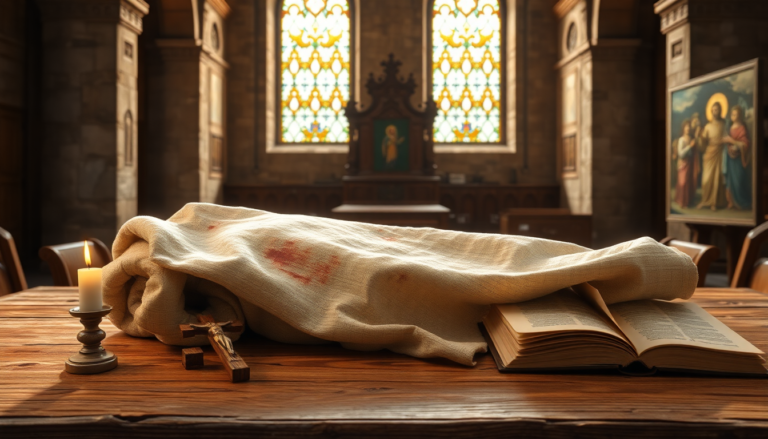
Hey friends! So, I stumbled upon some fascinating news about the Shroud of Turin that totally blew my mind! 🧐 A new study just dropped, and it’s shaking things up by potentially supporting what the Bible says about Jesus’ burial. Are you ready for some science mixed with history? Let’s dive in! 💡
The Shroud’s Background and Its Biblical Significance
First off, let’s chat about what the Shroud of Turin actually is. This piece of linen, measuring around 14 feet by 3 feet, has been a topic of debate for centuries. Many believe it bears the image of a man who resembles Jesus, wrapped in the cloth after crucifixion.
According to biblical accounts, His body was wrapped with spices in this linen. But here’s the kicker: a 1998 study suggested that His body was washed before burial, which kinda contradicts the scripture. 🤔
Enter Dr. Kelly Kearse, an immunologist with some serious chops from Johns Hopkins University.
He decided to revisit the ‘washing hypothesis’ that forensic pathologist Dr. Frederick Zugibe put forward. With a fresh perspective, Dr. Kearse examined blood samples under conditions mimicking those after death—think reduced clotting and increased acidity. This is giving me major ‘science meets scripture’ vibes! 📖✨
Key Findings from the Study
Dr. Kearse’s findings were pretty compelling. He discovered that the bloodstains on the Shroud align with Jewish burial customs that prohibit washing the bodies of those who died violently. This means all the blood from trauma must stay with the body. One of the coolest parts? He found these serum halos—clear rings around blood clots—on many wounds on the Shroud. These halos typically appear only if the blood started to clot before it touched the cloth. So, does that mean the Shroud’s blood came from freshly wounded, unwashed skin? 🤯
Now, let’s break it down a bit more. The presence of these serum halos strongly suggests that the blood came from an unwashed body. Dr. Kearse pointed out that if the blood had oozed from a washed body, the blood patterns would look completely different. He even ran tests on dried blood samples to compare. When blood clotted naturally, the halos appeared, but they didn’t show up when the blood was altered to mimic post-mortem conditions. Who else finds this super intriguing? 😍
Implications for the Shroud’s Authenticity
Okay, so here’s the plot twist: while Dr. Kearse’s findings are fascinating, they don’t exactly prove the Shroud’s authenticity. What they do is offer some solid support for the biblical narrative of Jesus’ burial. The Shroud first made its public appearance in 1354, and although it was initially dismissed as a fake, the Catholic Church has since embraced it as genuine. Still, radiocarbon dating from the 1980s points to a Middle Ages origin—so the debate continues! ⏳
Dr. Kearse theorizes that if the body hadn’t been washed, the blood could have transferred to the Shroud in a couple of ways. One theory is that fresh blood clots adhered to the cloth while still soft. Another is that dried blood on the body rehydrated in the damp tomb, allowing it to stick to the linen. And some researchers even suggest a supernatural event linked to Jesus’ resurrection could have played a role. Mind-blowing, right? 🌌
So, what do you think? Is this new evidence enough to change how we view the Shroud of Turin? Or do you think it’s just another piece in a long puzzle? Let’s chat about it! 💬 #ShroudOfTurin #BiblicalEvidence #ScienceAndFaith
