

U.S. Special Forces Execute High-Stakes Operation to Capture Venezuelan Dictator Nicolás Maduro Explore the strategic and daring mission undertaken by U.S. special forces aimed at apprehending Nicolás Maduro, the controversial leader of Venezuela. This operation exemplifies the intricate planning and execution involved in high-risk international missions.
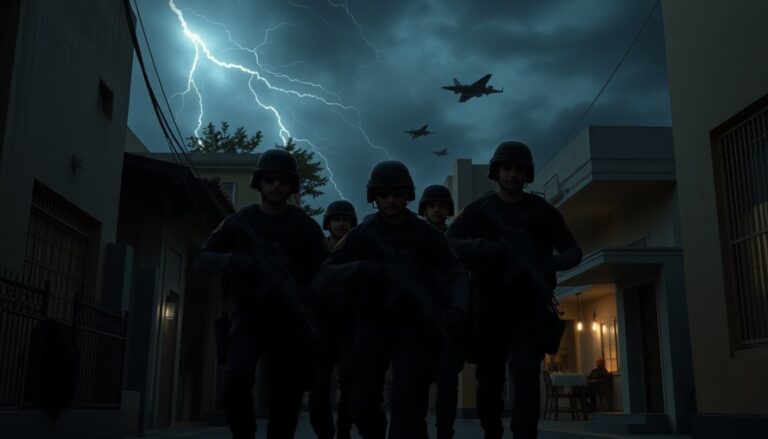
In a significant development, the U.S. military executed a calculated operation in Caracas, resulting in the capture of Venezuelan President Nicolás Maduro. Named Operation Absolute Resolve, this mission highlighted the capabilities of American forces and their intent to reshape the political landscape in Venezuela.
The execution of Operation Absolute Resolve
Beginning around midnight, approximately 150 military aircraft—including advanced F-22 Raptors, stealthy F-35s, and various support planes—departed from multiple bases and naval vessels strategically placed throughout the Caribbean. The operation’s objective was to neutralize Maduro’s air defenses, enabling ground forces to penetrate his fortified compound.
Strategic airstrikes and electronic warfare
At 2 AM, the mission intensified. Explosions echoed across the Caracas skyline, leading to the destruction of critical military sites such as Fuerte Tiuna and Carlota Airbase. U.S. Navy destroyers launched Tomahawk missiles to dismantle Russian-supplied air defense systems, while electronic warfare aircraft disrupted communications, causing a temporary blackout across the nation.
These coordinated strikes not only incapacitated Venezuelan defenses but also paved the way for the insertion of U.S. special forces into the capital. Helicopters from the 160th Special Operations Aviation Regiment, including MH-60 Black Hawks and MH-47 Chinooks, were deployed to deliver operators directly to the target area.
Ground assault on Maduro’s compound
With air support providing cover, special forces teams landed shortly after 2 AM. Equipped with advanced night vision technology, they navigated through the mountainous terrain surrounding Caracas. Upon arrival, Delta Force operators and FBI agents stormed the primary military headquarters, facing resistance from Maduro’s elite bodyguards, known as the Avispas Negras.
Rapid breach and extraction
In a series of meticulously planned maneuvers, the special forces breached Maduro’s compound within thirty minutes. Using flashbangs to disorient the guards, they advanced rapidly through the defenses. Despite the formidable presence of Cuban special forces, U.S. operators gained the upper hand with superior training and firepower, employing HK416 assault rifles to overpower the defenders.
As the chaos unfolded, Maduro and his wife attempted to seek refuge in a reinforced panic room. However, American troops intercepted them before they could escape. This operation was facilitated by extensive preparations, including the construction of a replica of the dictator’s safe house, which allowed U.S. forces to familiarize themselves with the layout.
Aftermath and implications
By 4:29 AM, Maduro and his wife were on a Chinook helicopter heading to the USS Iwo Jima, a warship stationed in the Caribbean. This military action concluded Maduro’s twelve-year reign and raised critical questions about Venezuela’s future political landscape. U.S. President Donald Trump stated that this operation could serve as a cautionary tale for others in Maduro’s regime, emphasizing the potential for further military action if deemed necessary.
The operation’s planning spanned several months, drawing on decades of experience in complex military maneuvers. Intelligence gathered from various U.S. agencies, including the CIA, was crucial for the mission’s success. Comprehensive surveillance efforts and ground intelligence played a significant role in ensuring the operation’s precision.
As Maduro faces serious charges, including narco-terrorism, his capture marks a pivotal moment for Venezuela, which now finds itself in a precarious transitional phase. The ramifications of this operation will likely resonate for years, potentially reshaping not only Venezuela’s future but also the geopolitical dynamics of the region.
