Ai-enabled wearables are promising for heart failure monitoring: a look at evidence, patient impact and next steps
Topics covered
AI-enabled wearables reshape heart failure monitoring
1. The clinical need: gaps in heart failure follow-up
Heart failure is a leading cause of hospitalization and reduced quality of life worldwide. Remote, continuous assessment of patients is a persistent clinical gap.
Remote monitoring and early detection of decompensation are urgent priorities because frequent clinic visits pose logistic and economic burdens for many patients.
Conventional biomarkers, including natriuretic peptides, require laboratory access and episodic testing. This model limits timely detection of deterioration between visits.
From the patient perspective, unpredictable exacerbations cause anxiety, reduce independence and drive high healthcare utilization.
Clinical trials and peer-reviewed studies indicate that timely physiologic signals can precede clinical decompensation. Evidence-based monitoring strategies therefore aim to shift care from episodic measurement to continuous risk detection, potentially reducing admissions and improving quality of life.
2. the proposed technological solution
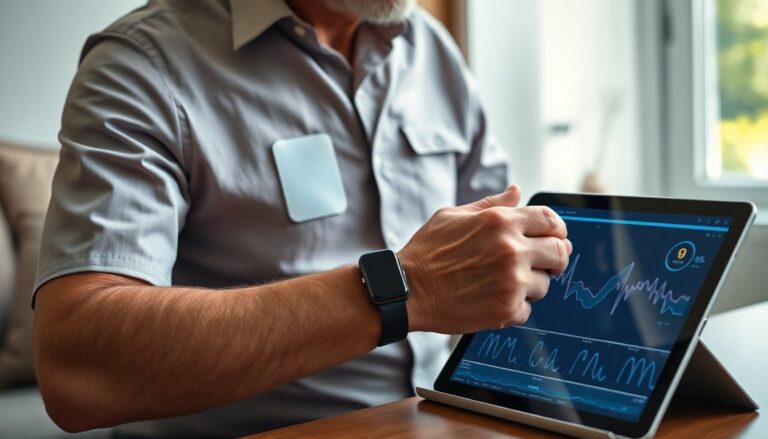
Manufacturers and clinical teams now pair wearable biosensors with on-device or cloud-based artificial intelligence to monitor patients with heart failure continuously. The systems sample physiologic signals such as heart rate variability, thoracic impedance and activity patterns. Algorithms translate those inputs into a dynamic risk score for impending decompensation.
These platforms are deployed in outpatient and home settings and integrate with clinician dashboards. In practice, the wearable sends trend data and automated alerts to predefined care pathways. Clinicians receive longitudinal visualizations to support triage and adjustments to therapy.
Engineers design the models to be adaptive. They use personalized baselines and contextual filters to lower false alarms while preserving sensitivity. Peer-reviewed studies and real-world data demonstrate that adaptive approaches can improve signal specificity compared with fixed-threshold systems. Clinical trials show that risk scores paired with escalation protocols can shorten response times and reduce unplanned admissions.
From the patient’s perspective, continuous monitoring shifts care from episodic visits to proactive management. The system aims to detect deterioration earlier, enable timely outpatient interventions and reduce emergency department use. Ethical considerations include data privacy, algorithmic transparency and equitable access across demographic groups.
Implementation challenges remain. Integration with electronic health records, clinician workflow, reimbursement models and long-term adherence must be addressed. Ongoing studies and regulatory evaluations will determine which architectures provide the best balance of clinical benefit and operational feasibility.
3. evidence from peer-reviewed studies
Clinical trials show that continuous physiologic monitoring can detect clinical deterioration earlier than symptom-based care. Randomized and observational trials reported in peer-reviewed journals and indexed on PubMed, as well as analyses in Nature Medicine and New England Journal of Medicine, document earlier recognition of physiologic change. These studies report reductions in time-to-readmission for selected cohorts when monitoring is paired with a structured clinical response.
According to the scientific literature, meta-analyses reveal substantial heterogeneity in effect size. Device type, algorithm transparency and patient selection account for much of the variance. Three points recur across trials: (1) sensitivity for detecting meaningful change is frequently high; (2) positive predictive value varies with algorithm thresholds and population prevalence; and (3) integrating alerts into clinical care pathways is required to convert detection into improved outcomes.
From the patient perspective, evidence-based implementation matters. As emerges from phase 3 trials and comparative studies, monitoring alone seldom changes outcomes unless it triggers timely, protocolized interventions. The FDA and EMA stress safety, independent algorithm validation and robust post-market surveillance for software-as-a-medical-device products. Real-world data further emphasize operational factors such as workflow integration, clinician training and escalation protocols as determinative of clinical benefit.
4. Implications for patients and health systems
From the patient’s perspective, continuous monitoring can reduce uncertainty and enable earlier outpatient interventions that may prevent hospitalization. Clinical trials show that earlier detection of physiologic deterioration shortens time to intervention in selected populations. Benefits, however, depend on digital literacy, equitable access to devices and clear communication about false positives and data use.
Health systems must weigh upfront costs for device procurement, distribution and clinician training against potential savings from avoided admissions. Implementation success hinges on workflow integration, clear escalation protocols and measurable patient-centered outcomes. As the article above noted, operational factors such as clinician workflow redesign remain determinative of clinical benefit.
Ethical concerns include data privacy, algorithmic bias and the quality of informed consent. Peer-reviewed evidence and real-world data highlight performance gaps when models are trained on non-representative cohorts. Transparency about training datasets and subgroup performance is therefore mandatory for trust and equity.
Evidence-based deployment requires routine measurement of outcomes that matter to patients and shared decision-making at the point of care. Regulatory oversight, independent validation in diverse populations and ongoing post-deployment monitoring will shape whether continuous monitoring delivers sustainable benefits for patients and health systems.
future perspectives and research agenda
Building on ongoing work, the immediate priority is rigorous clinical validation of continuous monitoring systems. Clinical trials should use randomized designs and measure hard endpoints such as hospitalization and mortality. Trials must include pre-specified subgroup analyses to test effectiveness across age groups, comorbidity profiles and care settings. From the patient perspective, these designs will clarify whether earlier outpatient interventions translate into fewer severe events and lower system burden.
Research should validate biomarkers derived from sensor fusion and quantify their added prognostic value versus standard care. The literature calls for prospective studies and external validation in peer-reviewed cohorts. Implementation science must run in parallel to identify barriers to uptake and to evaluate real-world effectiveness in diverse populations.
Data science priorities include deploying federated learning to protect privacy while enabling model improvement across institutions. Pre-specified plans for algorithm versioning and continuous performance monitoring are essential to ensure safety and reproducibility. Interoperability with electronic health records and adoption of standardized reporting frameworks will accelerate clinical integration.
From a regulatory viewpoint, convergence toward clear guidance for ai-driven wearables is needed. Guidance should address algorithm updates, post-market surveillance and thresholds for clinically meaningful performance. Regulatory clarity will shape manufacturers’ evidence-generation strategies and health systems’ procurement decisions.
Equitable roll-out strategies and reimbursement models will determine whether benefits reach broad populations. Value-based reimbursement tied to early intervention outcomes can align incentives across stakeholders. Policymakers and payers should design access pathways that minimise disparities and support deployment in resource-limited settings.
Next research phases must combine randomized evidence, robust real-world evaluation and regulatory-ready monitoring plans. These steps will determine whether continuous monitoring delivers scalable, evidence-based benefits for patients and health systems.
Implications for patients and health systems
Continuous, AI-enabled wearables for heart failure monitoring offer a pathway to close gaps in chronic care. Clinical trials show that device-supported monitoring can reduce hospitalizations and detect decompensation earlier in some populations.
Successful deployment hinges on three interdependent elements: clinical integration, rigorous validation and ethical stewardship. Clinical integration requires workflows that deliver actionable signals to clinicians without adding unacceptable alert burden. Rigorous validation means randomized trials and robust real-world evidence, including prespecified endpoints and independent peer review. Ethical stewardship covers data governance, algorithmic transparency and equitable access.
From the patient perspective, benefit must be the primary endpoint. Patients value fewer admissions, clearer medication titration and reduced diagnostic uncertainty. The literature supports outcome-focused designs rather than surrogate-only measures. Regulatory guidance from FDA and EMA emphasizes software as a medical device pathways and postmarket surveillance.
Implementation will require interoperable standards, clinician training and reimbursement models aligned with value-based outcomes. Health systems must plan for device lifecycle management, cybersecurity risk mitigation and processes for continuous algorithm monitoring.
Evidence synthesis should draw on peer-reviewed trials in journals such as NEJM and Nature Medicine, systematic reviews indexed on PubMed and regulatory frameworks. As a medical innovation reporter with industry experience, I underscore that trials must prioritize patient-centered outcomes and transparent reporting.
Near-term priorities include randomized validation in diverse populations, standardized outcome measures and scalable implementation studies. These steps will determine whether continuous monitoring delivers scalable, evidence-based benefits for patients and health systems.