

Hungary is facing an unprecedented energy crisis as record-low water levels in the Danube have forced the shutdown of nuclear reactors and revealed long-buried relics.
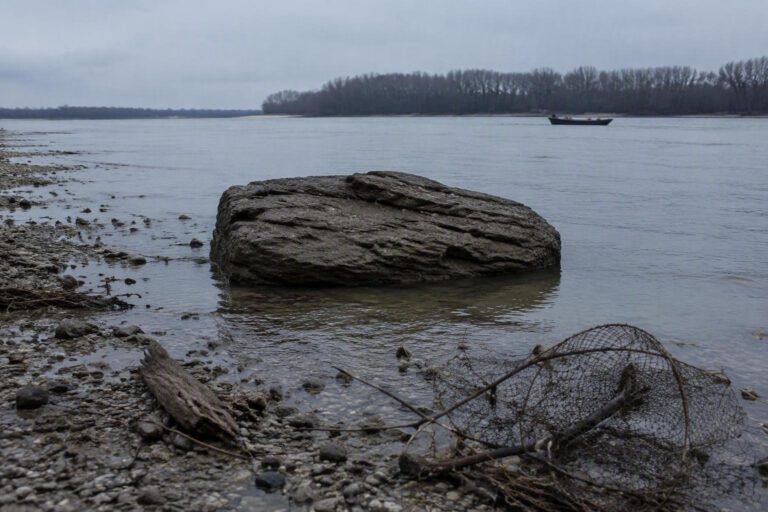
The Danube River, a lifeline for Hungary and the European Union’s longest river, has reached historic lows, exposing ancient relics and triggering an unprecedented energy crisis. The Rock of Starvation a boulder that once warned of impending famine, has resurfaced in its entirety, astonishing geologists and government scientists.
This crisis has forced Hungary to shut down all but one of its Danube-cooled nuclear reactors for the first time in 44 years.
The Guardian embarked on a journey along the Danube, visiting villages and towns where residents are struggling to secure drinking water and farmers are fighting to keep their crops alive.
The drought has caused widespread economic damage, surpassing the historic dry spell of 2026.
The Human Impact of the Drought
In Pócsmegyer a village on the Danube, István Somogyi a 56-year-old farmer, has lost nearly 50% of his harvest this year.
“I’ve lost nearly 50% of my harvest this year and it could go up to 70%,” he said. “It’s gone. Everything has dried up.” Somogyi’s plight is shared by many farmers along the Danube, who are witnessing the devastating effects of the drought firsthand.
The drought has also disrupted energy supplies, leaving some Hungarian towns struggling with shortages of drinking water. In Szentendre a town known for its community of artists, vast, desert-like islands have emerged. The exposed riverbed is cracked like a mosaic of hard, dry clay, baked by suffocating heat that has pushed temperatures in Budapest close to 42C with overnight temperatures hitting a high of 28C.
The Emergence of Long-Buried Relics
The water levels have fallen so dramatically that the Danube has revealed a succession of relics long hidden beneath its waters, including the remains of a woolly mammoth, a bridge destroyed after the second world war in Budapest, a Nazi warship, and an unexploded British bomb. The water is so low in the capital that on 28 JulyGábor Kürti president of the Magyar Kerékpárosklub (Hungarian cyclists’ club), rode for 30km along the exposed bed of the Danube, an unprecedented feat that quickly went viral on social media.
Kürti’s journey highlighted the severity of the crisis. “I wanted to show that if you can cycle along the bed of the Danube for 30km, it means that, because of this climate emergency, we have literally hit rock bottom,” he told the Guardian. The journey was both an extraordinary adventure and a heartbreaking reminder of the scale of the catastrophe.
The Energy Crisis and the Future
The drought and resulting disruption to energy supplies have left some Hungarian towns struggling with shortages of drinking water. In Paks home to Hungary’s nuclear power plant, municipal workers have been working weekends to keep more than 700 threatened trees alive and water the town’s flowerbeds. “I’ve been doing this job for 18 years,” said Szilvia Farkas 39, who is employed by Dunakom Zrt in Paks. “I have never seen so much vegetation dry out in all my years doing this job, and I have never worked as hard as I have this year to try to keep it alive.”
The crisis has also compounded longstanding problems for thousands of people who were already living in difficult conditions before the drought, struggling with inadequate access to running water and sewage systems. Géza Orsós Renáta 43, who lives with her four children in a small farmhouse on the outskirts of Paks, has never had access to running water. “Even in winter, we have to pump water and heat it in large bowls so we can wash,” she said. “Now a friend brings us water once a week. But it is becoming unbearable.”
As the drought continues, people can do little but cling to the hope that the Rock of Starvation will disappear once more beneath the currents of the Danube. However, Somogyi, who grew up hearing the story of the boulder passed down through generations, knows it will not. “The drought will return next year,” he said. “That is the trend. And there isn’t much that we can do.”
