

An EMR train smashed into a stopped service near Elstow on 19 June 2026, killing driver Shaun Burton and wounding more than 160 passengers, according to an early RAIB investigation.
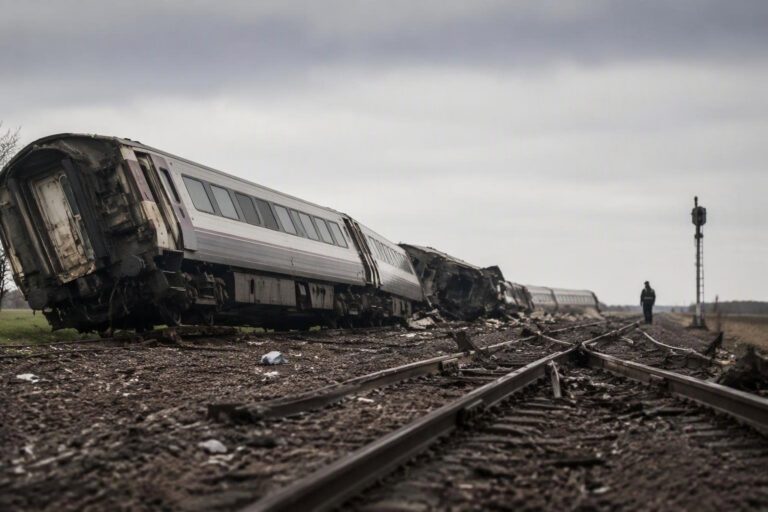
On the evening of 19 June 2026 a passenger service operated by East Midlands Railway (EMR) failed to stop at a red signal and struck a stationary train on the Midland Main Line near the village of Elstow, Bedfordshire. The impact claimed the life of the 60-year-old driver, Shaun Burton and left over 160 of the roughly 257 people on board injured.
The collision also caused both trains to derail, prompting a massive disruption to services between Nottingham and London St Pancras.
Chronology of the crash
According to the interim report released by the Rail Accident Investigation Branch (RAIB) the forward train – identified as 1H46 – approached signal WH154 at a speed of about 58 mph.
Data from the train’s on-board recorder shows the driver acknowledged the yellow warning aspect, but the train continued to accelerate. At 17:12:53 the signal was at a dangerous red aspect, yet the train passed it, reaching approximately 75 mph while only 200 metres from the rear of the stationary service (1B67).
Approximately ten seconds before impact, the driver applied the full service brake. Two seconds later the emergency brake was engaged, but the train’s speed had already fallen to around 50 mph when it collided with the rear of the stopped train. CCTV footage captured the moving train about 600 metres away from the point of impact, and the curvature of the line limited the view of the stationary train, a factor highlighted by investigators as a possible visual constraint for the driver.
Why the signal was red
The stationary train had halted unexpectedly after an automatic warning system fault forced its brakes to apply. This unplanned stop forced signal WH154 to change automatically to red, as per the signalling logic designed to protect trains on the line. The RAIB report notes that drivers are trained to expect the next signal to be red after a yellow warning and to “control the speed of their train to allow them to stop before it.” In this case, however, the data shows the train continued to accelerate after acknowledging the red aspect, a breach of standard operating procedures.
Investigators from the British Transport PoliceNetwork Rail and the RAIB are analysing the black-box data, forward-facing CCTV, and signal logs to determine why the driver failed to observe the red aspect. The report emphasizes that early-stage investigations often describe only the immediate events; the underlying causes – whether technical, human factors, or a combination – will be uncovered as the inquiry proceeds. The RAIB has stated it will keep examining the status of the train’s braking and safety systems, as well as any external influences that may have affected the driver’s decision-making.
For now, the focus remains on supporting the injured passengers, securing the derailed rolling stock, and restoring normal service on the Midland Main Line. The tragic loss of Shaun Burton underscores the critical importance of strict adherence to signalling protocols and the continual review of safety systems across the UK rail network.
