

Key European leaders come together in Washington to support Ukraine's fight against Russian advances.
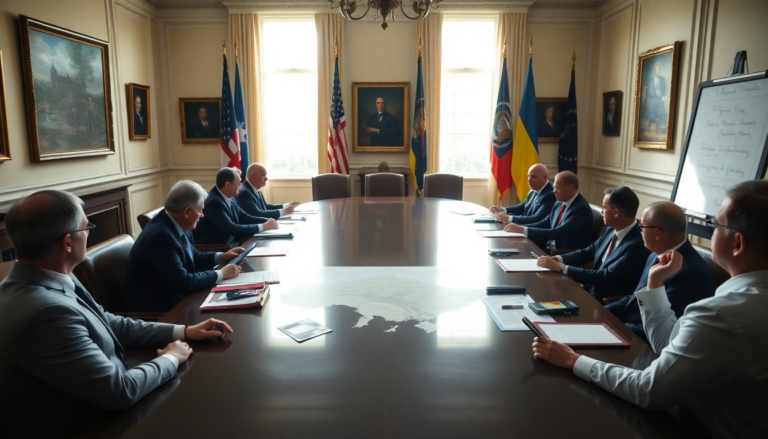
In a pivotal meeting at the White House, UK Prime Minister Sir Keir Starmer and six other European leaders are joining forces with Ukrainian President Volodymyr Zelensky to present a united front against Russian aggression. The discussions, set for Monday, are crucial as they aim to ensure Ukraine doesn’t have to concede territory to Russia under the guise of peace.
The Meeting’s Significance
This high-stakes summit underscores just how urgent the situation in Ukraine has become. Alongside Starmer, notable figures like France’s Emmanuel Macron, Germany’s Friedrich Merz, Italy’s Giorgia Meloni, and Finland’s Alexander Stubb will be present. Also in attendance are NATO chief Mark Rutte and European Commission President Ursula von der Leyen.
The main focus of this meeting is to bolster Ukraine’s position, especially given the expected pressure from U.S. President Donald Trump for concessions regarding the Donetsk and Luhansk regions—areas heavily controlled by Russian forces. These mineral-rich territories are vital for Ukraine’s economy and security.
Zelensky is gearing up to tackle these demands, which could lead to a precarious compromise. But how far is he willing to go?
As the meeting draws near, tensions are palpable. Reports suggest that Trump may propose a long-term peace deal. However, Secretary of State Marco Rubio warns that such an agreement is “still a long ways off.” The U.S. administration has hinted at potential further consequences for Russia if it refuses to engage in peace talks. Could this be a turning point?
Reactions and Expectations
European leaders are clear: the decision on how to end the conflict ultimately lies with Ukraine. They’ve praised Zelensky’s unwavering commitment to achieving a “just and lasting” peace but are wary of Trump’s fluctuating stance on ceasefire negotiations.
At a recent press conference, von der Leyen emphasized that both a ceasefire and a peace deal are essential to “stop the killing.” Zelensky echoed this sentiment, advocating for a ceasefire to allow discussions on a final agreement to take place. “It’s impossible to do this under the pressure of weapons. So it’s necessary to cease fire and work quickly on a final deal,” he asserted. How will these leaders balance the urgency of peace with the realities of warfare?
The coalition of European leaders, including Starmer, is prepared to urge Trump to commit to enhancing Ukraine’s military capabilities. This follows previous tensions during Zelensky’s last visit to the White House, where accusations of ingratitude towards the U.S. stalled crucial aid to Ukraine. Will this meeting change the narrative?
Timeline of Events
As the situation unfolds, tracking the timeline of events becomes vital. The meeting on Monday marks a critical juncture in international diplomacy regarding Ukraine’s future. Previous discussions and agreements will significantly influence the outcomes of this summit. The coalition leaders have reaffirmed their support for Ukraine, highlighting the need for a strategic approach to deter future Russian aggression.
In the lead-up to the meeting, both Zelensky and the European leaders are gearing up to present a united front, seeking a strong response from Trump and his administration. The outcome of this meeting could have enduring effects for Ukraine and its allies as they navigate ongoing hostilities. What’s at stake for all involved?
Conclusion
This gathering of European leaders and President Zelensky transcends immediate negotiations; it’s about shaping Ukraine’s future amid a backdrop of uncertainty and conflict. The determination displayed by these leaders signals a profound commitment to ensuring that Ukraine maintains its sovereignty and is shielded from further incursions. Are we witnessing a pivotal moment in the fight for Ukraine?
