

As protests against the Palestine Action ban escalate, Defend Our Juries urges police to avoid arrests of peaceful demonstrators.
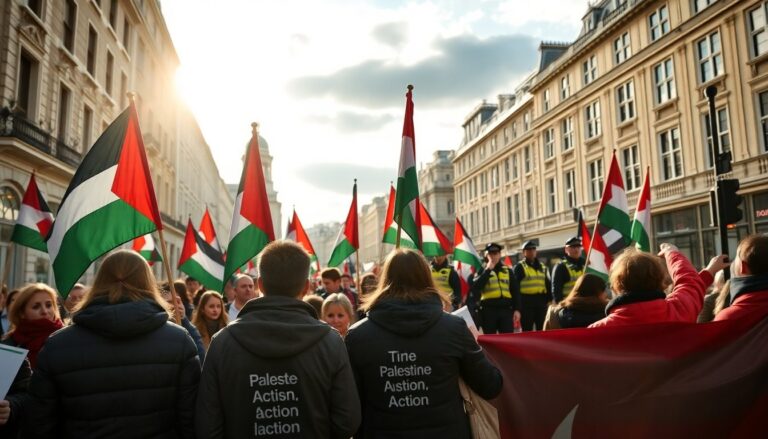
In a significant move ahead of scheduled protests on Saturday against the ban on Palestine Action, the campaign group Defend Our Juries (DOJ) has urged Metropolitan Police Chief Sir Mark Rowley to instruct officers to refrain from arresting peaceful protesters.
The rally, set to occur in London, Belfast, and Edinburgh, aims to highlight ongoing issues surrounding Palestine Action and the recent legal challenges faced by its supporters.
Protests Planned Across Major Cities
Hundreds of demonstrators are expected to gather in various locations, with a significant concentration in Parliament Square, where over 1,000 participants are anticipated to silently hold signs stating, “I oppose genocide.
I support Palestine Action.” This rally is part of a growing movement opposing the classification of Palestine Action as a terrorist organization.
In a letter sent to Sir Mark Rowley on Friday, DOJ emphasized the need for police to avoid unnecessary arrests during the protest.
This call follows similar decisions by police forces in Edinburgh, Totnes, Derry, and Kendal, which opted not to arrest individuals simply holding signs. DOJ’s letter stated, “You do not need to endlessly repeat the embarrassing charade of arresting people who are acting peacefully and lawfully in front of the world’s press, bringing policing into disrepute.”
Concerns Over Policing and Public Sentiment
The organization expressed concerns regarding the potential toll such policing approaches could take on officers, urging a reconsideration of tactics in light of increasing numbers of participants. The letter noted, “As the hundreds start to become thousands, maybe it’s time to put a cap on your losses and give your hardworking and overstretched men and women some well-deserved rest?” This highlights a growing tension between law enforcement and public demonstrations related to Palestine Action.
As protests gain momentum, DOJ has pointed to the heavy emotional burden placed on officers facing public backlash for enforcing controversial laws. DOJ voiced support for officers, stating, “No more violations of international law, no more officers wondering how long they can tolerate serving in a force that compels them to carry away elderly, frail vicars into police vans and police cells.”
Legal Challenges and the Implications of the Ban
The protests come on the heels of legal troubles for six individuals allegedly connected to DOJ, who appeared in court to contest charges related to organizing gatherings intended to render the Palestine Action ban unenforceable. The police have characterized Palestine Action as a terrorist group following a controversial ruling that proscribed the organization in July after it claimed responsibility for damaging RAF Voyager planes.
Detective Chief Superintendent Helen Flanagan of Scotland Yard’s counter-terrorism command reiterated the seriousness of the situation, stating, “Palestine Action is clearly proscribed as a terrorist group, and those showing support for this particular group, or encouraging others to do so can expect to be arrested, investigated, and prosecuted.” Meanwhile, the Home Office is set to appeal a High Court ruling that allows co-founder Huda Ammori to challenge the government’s designation of the group as a terrorist organization.
As the protests approach, the atmosphere remains charged, with all eyes on the response from law enforcement and the potential implications for the movement supporting Palestine Action.
