

Police and Sinn Féin join forces to address the persistent issue of paramilitary flags in Northern Ireland.
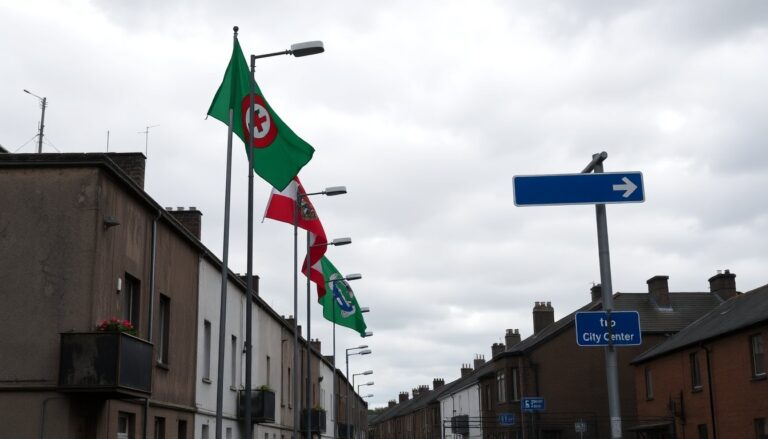
The Police Service of Northern Ireland (PSNI) is currently drafting a new agreement with a Stormont department overseen by Sinn Féin. This initiative aims to tackle the ongoing issue of paramilitary flags displayed throughout the region. The move follows persistent concerns regarding the promotion of paramilitary groups through such displays, which have sparked tension within local communities.
Understanding the Issue of Paramilitary Flags
Paramilitary flags are often raised in various neighborhoods, particularly in loyalist areas. These flags can serve as symbols of identity or political allegiance. The PSNI has reported sightings of flags supporting banned organizations, including the Ulster Volunteer Force (UVF) and the Ulster Defence Association (UDA).
Alarmingly, these flags have been placed in close proximity to PSNI stations. For instance, UDA flags were recently spotted on lampposts near the Knocknagoney PSNI station in East Belfast, alongside Union and Ulster flags.
During a recent meeting of the Policing Board, Chief Constable Jon Boutcher addressed the rising concern regarding these flags.
He stated that there is no tolerance for such displays but recognized the ‘challenging history’ surrounding the issue. This acknowledgment points to the complexities involved in enforcement and community relations. “Where there are flags that we can get down, we should take them down quickly,” he remarked, emphasizing the need for prompt action while ensuring safety.
Collaboration with Sinn Féin and Future Steps
Deputy Chief Constable Bobby Singleton disclosed ongoing discussions with the Department for Infrastructure, led by Sinn Féin minister Liz Kimmins. The PSNI’s priority is to establish a clear internal protocol before seeking broader cooperation. Singleton emphasized that a revised Memorandum of Understanding (MoU) would enable a more streamlined approach to flag removal, fostering collaboration between the police and the department.
Senior officers have already met with the infrastructure minister to discuss enhancements to the existing agreement, which has faced criticism for its ineffectiveness. Singleton noted that the previous MoU did not adequately address community concerns, leading to perceptions that the police were either indifferent or complicit in the flag displays. “It needs more work, it definitely does,” he stated, highlighting the importance of detailed discussions moving forward.
Current Status and Expectations
Currently, the PSNI is working diligently to refine operational guidelines for officers regarding paramilitary flags, with updated advice recently provided to staff. Singleton confirmed the existence of a previous MoU but acknowledged frustrations surrounding its application. The police force maintains operational discretion in handling these situations, allowing them to respond appropriately based on the circumstances.
While the timeline for the publication of the revised MoU remains uncertain, the commitment to enhancing the collaborative framework between the PSNI and Sinn Féin is clear. This partnership aims not only to improve the removal process but also to encourage constructive dialogue within affected communities about the implications of such displays.
