

Curious about the differences in arrest rates between the Notting Hill Carnival and the Unite the Kingdom rally? Let’s dive into the numbers and the narratives behind them!
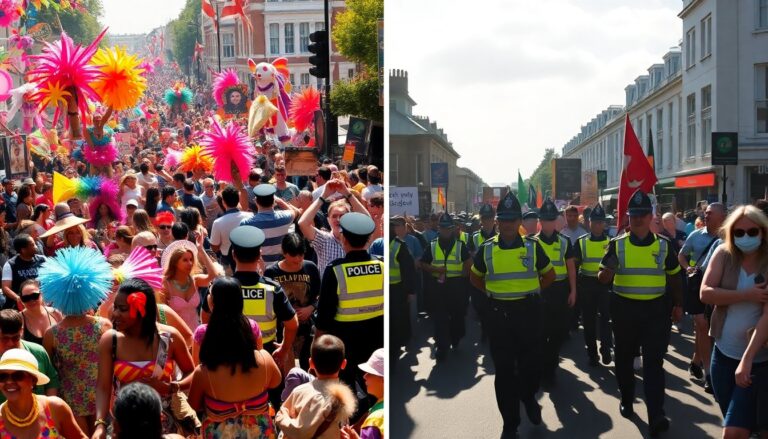
There has been considerable discussion regarding the significant differences in arrest rates at two major events in London: the Notting Hill Carnival and the Unite the Kingdom march. This disparity raises important questions about policing and public perception.
The Scene: Notting Hill Carnival vs. Unite the Kingdom March
Last month, the Notting Hill Carnival, known as Europe’s largest street party, recorded 423 arrests over two days. With an estimated attendance exceeding one million, this equates to approximately one arrest for every 2,364 participants. In stark contrast, during the Unite the Kingdom march, only 25 arrests occurred despite being labeled the largest right-wing rally in British history, which attracted between 110,000 and 150,000 attendees.
This means about one in every 6,000 marchers was arrested.
The notable difference prompts a deeper examination. Police reported facing “unacceptable violence” during the Unite the Kingdom rally, where officers encountered bottles, flares, and physical assaults. An extensive police presence, comprised of 1,000 officers, along with an additional 500 from surrounding areas, was deployed.
Several officers experienced severe injuries, including concussions and broken teeth.
Public Sentiment and Political Responses
There appears to be a significant discrepancy in how these events are policed and perceived by the public and political figures. Keir Starmer, leader of the Labour Party, condemned the violence at the march, affirming that while peaceful protest is a fundamental right, violence against police and intimidation of citizens is intolerable. He highlighted that the nation is founded on principles of tolerance and diversity.
Conversely, the Notting Hill Carnival, despite its own history of violence and disorder, is often scrutinized differently. The festival is celebrated for its cultural importance and economic contributions, providing around £400 million annually to London’s economy. However, local shopkeepers often prepare for chaos, boarding up windows in anticipation of the event’s potential disorder.
Looking Ahead: What Does This Mean for Future Protests?
In the aftermath of these events, the Metropolitan Police have indicated that the 25 arrests from the Unite the Kingdom rally may be only the beginning. They are launching investigations to identify those involved in the violence, asserting that perpetrators will face consequences. The message is clear: violence will not be tolerated, yet questions remain regarding the methods of enforcement.
Reflecting on these incidents, it is crucial to consider their broader implications. How do we reconcile the right to protest with public safety? Are we witnessing a shift in policing strategies for different types of protests? The disparity in arrest rates raises significant questions about societal attitudes and the current political landscape in the UK. Public opinion on whether the police response was justified will likely spark continued discussion.
