

Explore the evolving health and legal challenges faced by Jair Bolsonaro, the controversial former president of Brazil. Stay informed about the latest developments in this ongoing story.
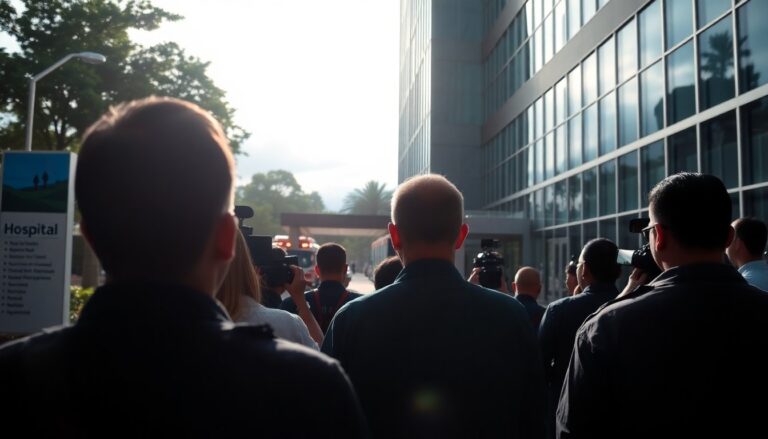
Jair Bolsonaro, the former president of Brazil, has been hospitalized in Brasília following a sudden health crisis at his residence, as confirmed by his son. This incident marks the second time Bolsonaro, aged 70, has required medical attention since being sentenced to imprisonment for his involvement in a coup plot last week.
The former army captain, who led Brazil from 2019 to 2023, has a history of severe intestinal complications stemming from a stabbing incident during his 2018 election campaign. His medical history includes at least six surgeries, with a particularly lengthy procedure lasting 12 hours occurring in April.
His son, Flavio, reported that Bolsonaro experienced a significant episode of hiccups, accompanied by vomiting and low blood pressure prior to being rushed to DF Star Hospital under the supervision of correctional officers.
Legal Troubles and Sentencing
Last Thursday, a panel of Supreme Court justices found Bolsonaro guilty of conspiring to undermine Brazil’s democratic processes after he lost the 2022 presidential election to Luiz Inácio Lula da Silva.
The court imposed a sentence of 27 years and three months, yet this ruling does not result in immediate incarceration. The court has a maximum of 60 days to publish the sentencing details, after which Bolsonaro’s legal team has a five-day window to request clarifications.
Denial of Wrongdoing
Throughout this ordeal, Bolsonaro has consistently denied any wrongdoing, framing his situation as a case of political persecution. His claims have garnered international attention, including support from former U.S. President Donald Trump, who labeled the legal proceedings as a “witch-hunt” and enacted a 50% tariff on Brazilian goods in response to the situation. Bolsonaro has been under house arrest since August, following allegations that he sought to pressure judicial authorities.
Controversial Remarks and Financial Penalties
In addition to his legal challenges, Bolsonaro faces a separate court ruling mandating him to pay 1 million reais (approximately $188,865) in damages for making racist comments while he was in office. This ruling stems from an incident in May 2021, when he made derogatory remarks to a Black supporter who approached him for a photograph, likening the man’s hair to a “cockroach breeding ground.” His legal representatives have maintained that these comments were intended as humor rather than a serious offense.
Public Reaction and Political Implications
The Brazilian populace remains divided over Bolsonaro’s sentence related to coup plotting, with supporters actively pursuing avenues to overturn or lessen his punishment. Allies of the former president in Congress are advocating for an amnesty bill, which aims to address the legal status of numerous supporters who vandalized government property in January 2023. São Paulo Governor Tarcísio de Freitas, a prominent Bolsonaro supporter, has expressed intentions to pardon the ex-president if he wins the presidency in the upcoming 2024 elections. Although a court has prohibited Bolsonaro from holding office until 2030, he continues to assert his ambition to participate in the 2026 presidential race.
Current President Luiz Inácio Lula da Silva has characterized the conviction of Bolsonaro as a landmark decision, emphasizing that it safeguards Brazil’s democratic institutions and legal framework. Lula has pointed out that the investigations leading to Bolsonaro’s sentencing revealed disturbing plots against his life, as well as that of the vice president and a Supreme Court justice.
The ongoing developments surrounding Bolsonaro’s health and legal battles have captured the attention of both national and international audiences, highlighting the tumultuous state of Brazilian politics and the contentious legacy of its former leader. As the situation evolves, the implications for Bolsonaro’s future and Brazil’s political landscape remain uncertain.
