

**BBC's Involvement in Eurovision: Navigating Political Tensions** The future of the BBC's participation in the Eurovision Song Contest is currently uncertain amid rising political tensions. As discussions unfold, stakeholders are closely monitoring the situation to assess potential impacts on the beloved annual event.
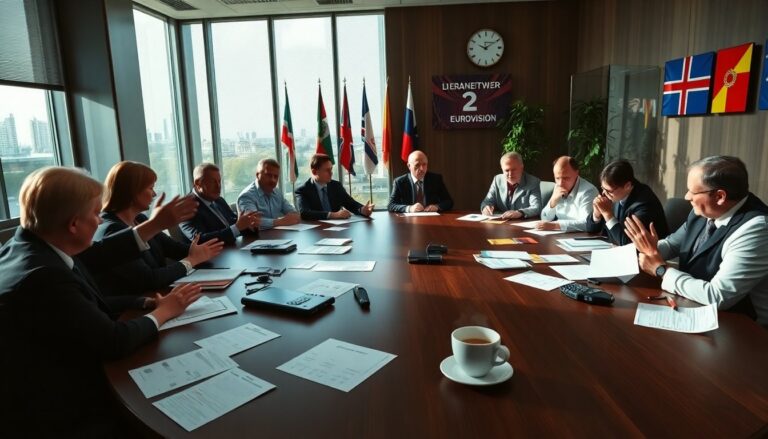
The future of the BBC’s involvement in the upcoming Eurovision Song Contest remains uncertain. Director-General Tim Davie has confirmed that a final decision will be made soon, amid escalating tensions surrounding Israel’s participation in the event.
This situation has emerged as broadcasters from several nations, including Spain, the Netherlands, Iceland, and Slovenia, have threatened to withdraw if Israel is permitted to compete.
The European Broadcasting Union (EBU), which oversees the contest, is currently consulting its members regarding participation and the geopolitical implications, with a deadline set for mid-December.
Understanding the Eurovision Dilemma
In an interview with BBC Radio 4’s The Media Show, Davie was asked about the BBC’s role in Eurovision.
He indicated that the EBU is reviewing the criteria for participation to determine necessary assurances regarding entries from various broadcasters. Davie stated, “We will allow them to complete their review before making a decision on our participation.”
Political Implications and Concerns
Davie noted that Eurovision has traditionally been seen as an apolitical event. However, he acknowledged the significant concerns raised by member countries. The decision by the Spanish public broadcaster RTVE to consider a boycott was made during a recent board meeting. Meanwhile, Slovenia’s RTVSLO, Ireland’s RTE, and Dutch broadcaster Avrotros have expressed intentions to withdraw if Israel competes.
The calls for a boycott stem from protests against Israel’s military actions in Gaza. Notably, prominent figures, including musician Phil Coulter, who co-wrote the UK’s winning entry in 1967, have criticized the perceived double standards in Eurovision’s participation criteria, especially following the exclusion of Russia and Belarus in recent years.
Eurovision’s Unique Position
The UK holds a special status in Eurovision as part of the Big Five, guaranteeing its place in the final due to substantial financial contributions to the EBU. Recent contests have seen various countries compete fiercely for the top spot, with this year’s winner being Austria’s JJ, performing the poignant ballad Wasted Love, while Israel’s Yuval Raphael finished as the runner-up.
Israel first participated in Eurovision in 1973 after joining the EBU. However, its participation has faced scrutiny over the past two years amid ongoing political disputes. Following Russia’s ban from the contest due to its invasion of Ukraine, the spotlight has now shifted to Israel’s continued involvement.
Future of Public Service Broadcasting
In light of these discussions, Davie addressed the broader future of the BBC at the Royal Television Society’s Cambridge Convention. He urged industry leaders to adopt a bold approach to ensure the relevance of public service broadcasting, as the government prepares to review the BBC’s charter and its funding model, currently linked to inflation until 2027.
Davie referenced insights from a recent public engagement survey, Our BBC, Our Future, emphasizing that the focus should extend beyond the BBC’s self-preservation to support the entire broadcasting sector. He stated, “Our priority is to ensure a fully funded public service BBC that serves the public effectively and enhances the UK’s cultural landscape.”
Despite facing criticism over various controversies, including allegations against prominent figures within the organization, Davie expressed confidence in the necessity of the BBC and its role within the industry.
Conclusion
This situation has emerged as broadcasters from several nations, including Spain, the Netherlands, Iceland, and Slovenia, have threatened to withdraw if Israel is permitted to compete. The European Broadcasting Union (EBU), which oversees the contest, is currently consulting its members regarding participation and the geopolitical implications, with a deadline set for mid-December.0
