

Anticipated Unrest in Paris Highlights Rising Citizen Frustration with Government Austerity Measures
As tensions rise in France, the capital city of Paris is preparing for a significant surge of protests against President Emmanuel Macron’s administration. Nearly one million demonstrators are expected to take to the streets, fueled by a wave of anti-government sentiment that echoes previous nationwide movements.
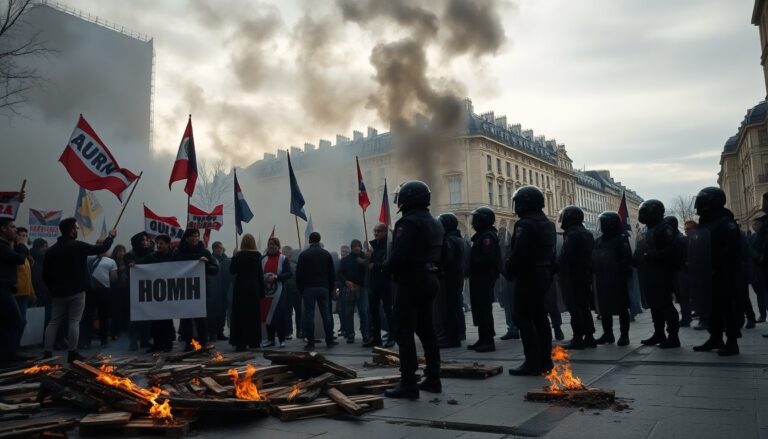
Early morning scenes in Paris depicted confrontations between police and protesters, signaling the potential for escalating violence. Demonstrators ignited wooden pallets near the Gare du Nord train station, creating a chaotic atmosphere filled with clouds of tear gas as officers attempted to maintain order.
Massive Turnout and Early Arrests
With estimates ranging between 600,000 and 900,000 participants, these protests are part of a coordinated effort against the government’s recent budgetary decisions. This comes on the heels of last week’s ‘Block Everything’ campaign, which laid the groundwork for what has been termed a ‘Black Thursday’ of strikes and unrest.
In the capital alone, reports indicated that more than 25 individuals were arrested by mid-morning as demonstrators obstructed vital transport routes, including the Paris Metro system and the city’s ring road. This unrest is not isolated to Paris; cities such as Marseille and Toulouse have also witnessed arrests related to anarchist groups like the ‘Black Bloc’ movement, notorious for its radical tactics.
Union Calls for Action
In a unified stand, all major French unions have rallied their members to protest against the government’s budget cuts, which aim to reduce spending by approximately £40 billion. The repercussions of these cuts are evident across numerous sectors, leading to widespread disruptions in public services, schools, and public transportation.
As the sun rose on the day of protests, many schools reported students blocking entrances, echoing calls to resist austerity measures with signs reading, ‘Block your high school against austerity.’ Among the demonstrators, a bus driver and member of the CGT union voiced the discontent felt by workers, stating that ‘workers are currently so despised by this government.’
Government Response and Security Measures
In anticipation of potential violence, authorities have deployed an extensive security presence throughout the city, including 80,000 police officers and gendarmes, along with armored vehicles and water cannons. The Interior Minister has acknowledged the heightened risks posed by small, radical groups that may attempt to infiltrate the larger, peaceful protests.
With over 250 planned rallies across the nation, officials are bracing for significant unrest and have issued warnings regarding the potential for property damage. The Interior Minister described the situation as a ‘hybrid’ event, blending legitimate protests with the risk of sabotage from extremist factions.
Public Sentiment and Future Implications
Despite the anticipated chaos, polling data indicates that approximately 56% of the French population supports the protests, although this figure is slightly lower than during the previous pension reform protests in early 2023. The current unrest is primarily aimed at the budget proposed by former Prime Minister François Bayrou, which has faced significant backlash.
Newly appointed Prime Minister Sébastien Lecornu has attempted to ease tensions by retracting one of the most unpopular budget proposals, the elimination of public holidays. Nonetheless, many fear that other unfavorable measures, such as changes to unemployment benefits, remain on the table, contributing to ongoing discontent among citizens.
Early morning scenes in Paris depicted confrontations between police and protesters, signaling the potential for escalating violence. Demonstrators ignited wooden pallets near the Gare du Nord train station, creating a chaotic atmosphere filled with clouds of tear gas as officers attempted to maintain order.0
