

**Preservation of a Historic 700-Year-Old Church Tower Amidst London Redevelopment** A remarkable 700-year-old church tower is embracing an innovative preservation strategy as part of a significant redevelopment project in London. This unique approach not only aims to maintain the architectural integrity and historical significance of the tower but also integrates it into the modern urban landscape. The redevelopment emphasizes sustainability, heritage conservation, and community engagement, ensuring that this iconic structure continues to be a vital part of London's rich history.
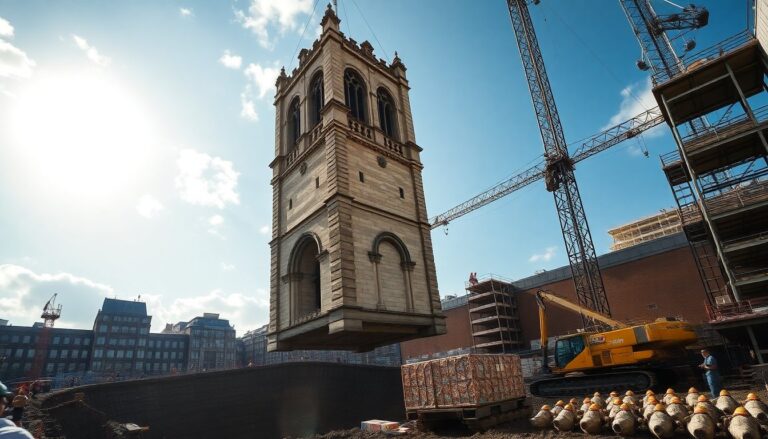
In a remarkable blend of history and modernity, a church tower dating back 700 years has been ingeniously suspended 45 feet above ground. This extraordinary feat of engineering is part of a significant building initiative in London, specifically at 50 Fenchurch Street.
The ancient All Hallows Staining Church tower, recognized as a Grade I listed structure, looms above a vast excavation site, symbolizing both preservation and progress.
On a notable Tuesday, the project celebrated a milestone with a ‘bottoming out’ ceremony, following the removal of over 125,000 tonnes of soil.
This excavation paves the way for a new 650,000 square foot office tower that aims to redefine the urban landscape while honoring the city’s rich heritage.
Preserving history amidst urban growth
The ambitious 36-story office development is set to replace a seven-story building that has housed the Clothworkers Livery Company for nearly five centuries.
The design integrates modern features while promoting a vision for a greener and more sustainable environment in London’s iconic Square Mile. As part of this venture, the church tower will eventually be reunited with ground level, enhancing public access through a newly designed green space.
A blend of heritage and innovation
This redesign aims to create a bustling business hub and includes state-of-the-art technology and amenities. A standout feature will be the tenth floor, offering a panoramic 360-degree public space. The project promises to enrich the community with additional facilities like an underground livery hall, retail spaces at ground level, and an expansive garden on the roof, all contributing to a vibrant urban ecosystem.
Leading this transformative project is Axa IM Alts, the investment arm of the French insurance giant, which is committed to fostering sustainable urban development. The All Hallows Staining Church, with its resilient tower dating back to the early 14th century, serves as a poignant reminder of the city’s enduring legacy.
Challenges and controversies in construction
Despite the innovative approach to preserving the tower, the project has faced opposition. Organizations like Historic Royal Palaces, which oversees the Tower of London, have raised concerns about potential obstructions to protected views of historic sites. Their fears were echoed by the Kuwaiti sovereign wealth fund, which sought legal intervention to halt the project, claiming it would interfere with light access to their nearby properties.
City’s commitment to sustainable development
The City of London Corporation, however, reiterated its commitment to sustainable urban planning, asserting that the development would not lead to unacceptable environmental impacts. Their thorough analysis concluded that factors such as noise, air quality, and light would remain within acceptable limits. The construction is set to continue until 2028, after which the historic tower will stand on stilts for an estimated year while subsurface work is finalized.
This project involves meticulous investigations into the original foundations of the tower, with archaeologists present to ensure the integrity of the site is maintained. This careful approach underscores the balance between innovation and respect for history, allowing the city to evolve without losing its cultural identity.
Howard Dawber, the deputy mayor for business and growth in London, attended the bottoming out ceremony and expressed enthusiasm for the project. He highlighted the importance of such developments in reinforcing London’s status as a premier destination for global business investment. The integration of historical elements with modern infrastructure exemplifies a commitment to creating a more inclusive and environmentally friendly urban space.
As the project unfolds, the All Hallows Staining Church tower will serve not only as a physical marker of London’s past but also as a symbol of its future. The dynamic interplay between the old and the new reflects the city’s ongoing narrative—one that respects its storied history while boldly embracing innovation.
