

**Demonstration in Berlin: Citizens Call for an End to Military Support for Israel** In Berlin, a large-scale demonstration is taking place as citizens rally for the cessation of military aid to Israel. The event underscores growing public sentiment against military assistance and advocates for a shift in foreign policy. Participants are expressing their views on the need for peace and diplomacy in the region, emphasizing the importance of addressing humanitarian concerns.
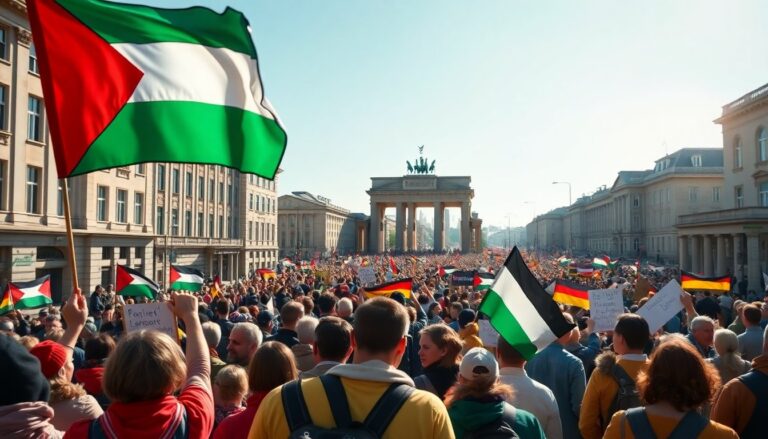
On a bright Saturday in Berlin, over 100,000 individuals gathered to protest against the German government’s support of Israel’s operations in the Gaza Strip. This significant turnout, organized by a coalition of approximately 50 groups—including pro-Palestinian organizations and human rights advocates—reflects a growing movement advocating for a reassessment of Germany’s role in the ongoing conflict.
Named the ‘All Eyes on Gaza – Stop the Genocide’ rally, the event clearly expressed public sentiment urging the government to withdraw its involvement in what many describe as genocide in Gaza. Protesters marched from Berlin’s City Hall to the Grosser Stern, displaying placards with messages such as “Stop the genocide in Gaza” and “Freedom for Palestine,” while chanting slogans like “Free, free Palestine.”
Demands for policy change
The organizers delivered a resolute message, calling for an immediate cessation of German military cooperation with Israel. They specifically urged a halt to the export, import, and transit of arms and military resources, emphasizing the necessity for a shift in Germany’s foreign policy.
The statement from the organizers referenced findings from numerous experts and international bodies that classify Israeli actions in Gaza as genocide. They stressed that the systematic violence perpetrated by the Israeli military is evident, yet the German government has continued to minimize these grave accusations.
Public opinion sways political landscape
Recent polling data indicates a significant shift in public opinion, with a YouGov survey revealing that 62% of German voters now view Israel’s actions in Gaza as genocidal. This sentiment cuts across political affiliations, as 60% of voters from the conservative CDU/CSU bloc also share this perspective, while an even larger 71% of Social Democratic Party (SPD) voters concur.
These statistics highlight the increasing pressure on Chancellor Merz’s center-right government to reevaluate its position on the Israeli-Palestinian conflict. Although Merz and Foreign Minister Johann Wadephul have recently intensified their critique of Israel’s military operations, they have refrained from using the term genocide, opting instead for phrases like “disproportionate use of force.”
International and humanitarian implications
The protesters’ demands extended beyond merely halting military support; they also called for enhanced access to humanitarian aid for the besieged population of Gaza. Many participants advocated for the implementation of sanctions against Israel by the European Union, reflecting calls for greater accountability in international relations.
As global leaders increasingly acknowledge the plight of Palestinians, countries such as France, the United Kingdom, Australia, and Canada have taken steps toward recognizing the State of Palestine. In this context, the German government’s reluctance to provide similar recognition has drawn criticism from protesters.
Germany’s role in the future
The large turnout in Berlin underscores an urgent need for the government to heed the voices of its citizens. The rally serves not only as a critique of Israel’s actions but also as a significant statement regarding Germany’s foreign policy and its implications for human rights. As the conflict persists and public sentiment evolves, the pressure on the government to align its actions with the values of its citizens will likely intensify.
The events in Berlin mark a crucial moment in the intersection of politics, public opinion, and international human rights advocacy. The pivotal question remains: will the German government respond to the call for change, or will it continue along a path that many citizens no longer endorse?
