

**Russia's Response to Potential US Military Support for Ukraine: Key Concerns and Implications** The geopolitical landscape is profoundly affected by Russia's reaction to the United States' potential military assistance to Ukraine. This situation has raised alarming concerns regarding regional stability and international relations. Key Points of Concern: 1. **Escalation of Tensions**: Russia perceives US military support as a direct threat, potentially leading to increased military confrontations. 2. **Impact on Ukraine**: Enhanced military aid for Ukraine could shift the balance of power, complicating peace efforts and prolonging conflict. 3. **Global Repercussions**: The situation has implications beyond Europe, affecting global security dynamics and alliances. Understanding the nuances of Russia's response is essential for policymakers and stakeholders invested in maintaining peace and security in the region.
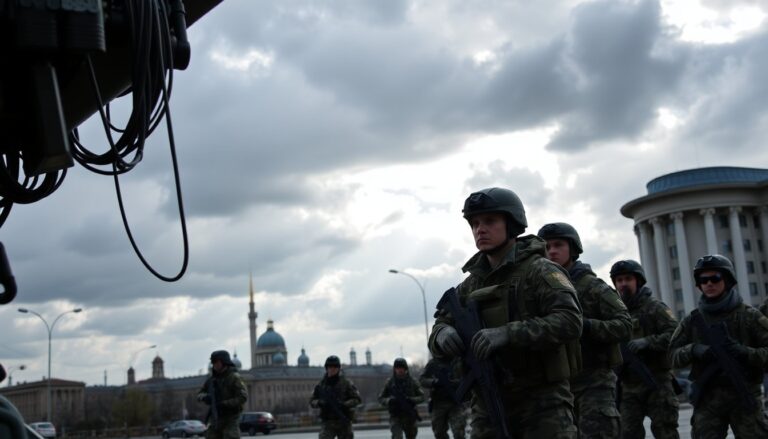
As Ukraine aims to bolster its military capabilities amidst ongoing conflict, the nation has formally requested long-range Tomahawk missiles from the United States. This request arises as US President Donald Trump reassesses his administration’s support for Ukraine, amid growing frustrations over Vladimir Putin‘s aggressive actions.
In a recent press briefing, Russian spokesperson Dmitry Peskov stated that the deployment of these missiles would not significantly impact the conflict’s trajectory. However, he warned that such a move might be seen as a violation of established norms, suggesting direct US interference in the conflict between Ukraine and Russia.
Understanding the implications of the missile request
During a meeting with Trump at the United Nations General Assembly, Ukrainian President Volodymyr Zelenskyy articulated his country’s need for Tomahawk missiles. These weapons would allow Ukraine to strike targets deep within Russian territory.
Historically, the US had limited Ukraine’s military actions to prevent escalating tensions with Russia. While strikes on Russian-held areas were permitted, the newly requested missiles could significantly expand Ukraine’s operational reach.
In a recent interview, Zelenskyy revealed that Trump had expressed a willingness for Ukraine to respond in kind to Russian provocations, including targeting energy infrastructure if Russia attacked Ukraine’s energy resources.
US officials weigh the request
US Vice President JD Vance confirmed that the Biden administration is considering Zelenskyy’s request for Tomahawk missiles, although the final decision rests with Trump. Additionally, Keith Kellogg, the US envoy to Ukraine, noted that the Trump administration had previously allowed Ukraine to conduct operations deep within Russian territory, asserting that there are no safe zones for the Russian military.
Tomahawk missiles are known for their long-range capabilities, capable of reaching targets between 1,250 km and 2,500 km (approximately 777-1,553 miles). Designed for stealth, these missiles can evade radar detection by flying at low altitudes and subsonic speeds, making them formidable assets in any military arsenal.
The strategic landscape of missile deployment
Despite Ukraine’s persistent requests for advanced weaponry, NATO allies have generally hesitated to provide such capabilities due to the risk of further escalation. Nonetheless, signs indicate a shift in this stance. For example, weeks before leaving office, former President Joe Biden relaxed restrictions on Ukraine’s weapon use.
Recent developments include the UK supplying long-range Storm Shadow missiles to Ukraine, which have a range of about 250 km (or 155 miles). Furthermore, the US has provided the Army Tactical Missile Systems (ATACMS), capable of striking targets up to 300 km (approximately 186 miles).
Ukraine’s own advancements in missile technology
In response to limitations imposed by its allies, Ukraine has made significant advancements in developing its own missile systems, such as the turbo-jet drone Paliantysia, with a range of approximately 650 km (about 404 miles). Additionally, Ukraine recently introduced the Flamingo, a ground-launched missile claimed to reach targets as far as 3,000 km (around 1,864 miles
Experts like Marina Miron from King’s College, London, suggest that while the Flamingo may exceed Tomahawk capabilities in terms of range, the request for US missiles likely stems from strategic considerations rather than immediate military necessity. Miron explained that acquiring such weapons could be a tactic for Ukraine to assess Russia’s response and potentially leverage negotiations for peace.
Potential consequences of US missile delivery
In a recent press briefing, Russian spokesperson Dmitry Peskov stated that the deployment of these missiles would not significantly impact the conflict’s trajectory. However, he warned that such a move might be seen as a violation of established norms, suggesting direct US interference in the conflict between Ukraine and Russia.0
In a recent press briefing, Russian spokesperson Dmitry Peskov stated that the deployment of these missiles would not significantly impact the conflict’s trajectory. However, he warned that such a move might be seen as a violation of established norms, suggesting direct US interference in the conflict between Ukraine and Russia.1
In a recent press briefing, Russian spokesperson Dmitry Peskov stated that the deployment of these missiles would not significantly impact the conflict’s trajectory. However, he warned that such a move might be seen as a violation of established norms, suggesting direct US interference in the conflict between Ukraine and Russia.2
In a recent press briefing, Russian spokesperson Dmitry Peskov stated that the deployment of these missiles would not significantly impact the conflict’s trajectory. However, he warned that such a move might be seen as a violation of established norms, suggesting direct US interference in the conflict between Ukraine and Russia.3
