

Liam Óg Ó hAnnaidh: A Case Study in Political Policing and the Definition of Terrorism Liam Óg Ó hAnnaidh's legal case has sparked significant debate regarding the implications of political policing and the evolving interpretation of terrorism. This case highlights the complexities surrounding governmental authority, civil liberties, and the criteria that classify actions as terrorist activities. Key discussions include: The impact of political motives on law enforcement practices. The...
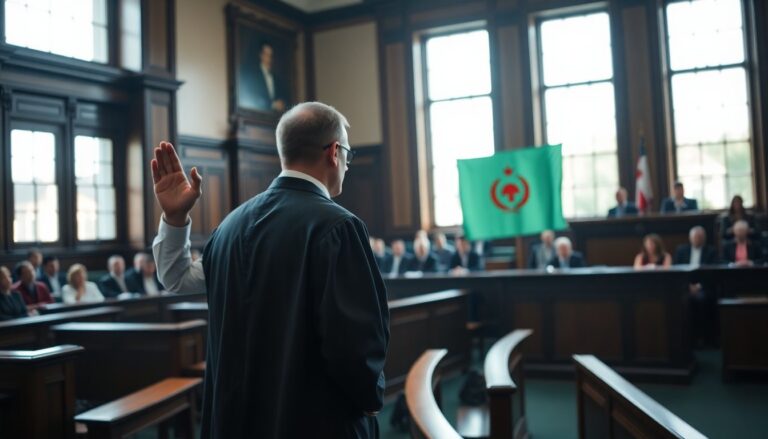
In a significant legal development, a 27-year-old resident of west Belfast is set to reappear in a London court, facing serious allegations related to a terrorism offense. The individual, known as Liam Óg Ó hAnnaidh, also referred to as Mo Chara from the band Kneecap, is charged with displaying a flag associated with a proscribed organization.
This charge stems from an incident during a performance in Kentish Town, where he allegedly held up a Hezbollah flag.
If found guilty under the provisions of the 2000 Terrorism Act, Ó hAnnaidh could face a substantial prison sentence. This courtroom encounter occurs in a political climate that has seen considerable shifts since his last appearance in June, despite the external semblance of continuity in the country.
Shifting political landscape and implications
Notably, just two weeks after Ó hAnnaidh’s initial court hearing, the British government officially designated Palestine Action as a terrorist organization. This group, which claims its actions are non-violent yet disruptive, gained notoriety for vandalizing military property to symbolize the plight of Palestinians.
The government’s decision coincided with the 20th anniversary of the devastating 7/7 bombings, an irony that seemed to escape many within the British establishment.
In a demonstration of the heightened tensions surrounding this issue, the Metropolitan Police set a record by detaining 474 individuals during protests against the ongoing violence in Gaza. Among those arrested were a diverse group, including elderly women and blind individuals in wheelchairs, highlighting the indiscriminate nature of the crackdown. One notable case involved a man mistakenly detained for wearing a t-shirt that stated, “I support plasticine action,” underscoring the absurdity of the ongoing situation.
Defining terrorism: A complex issue
Discussions around the definition of terrorism raise critical questions about the nature of protests and the actions of organizations like Palestine Action. Generally, terrorism is understood as the unlawful use of violence and intimidation against civilians for political purposes. By this definition, one might wonder whether the protesters, Ó hAnnaidh, or Palestine Action fit this label.
Home Secretary Yvette Cooper has been somewhat reticent regarding how the classification of Palestine Action correlates with their activities, hinting at undisclosed information due to ongoing investigations. This lack of clarity raises questions about the fairness and consistency of legal definitions being applied in these cases. Supporters of Ó hAnnaidh argue that, like Palestine Action, he is merely highlighting political hypocrisy and injustice.
Political policing and selective enforcement
The band Kneecap has publicly denounced the charges against Ó hAnnaidh as a form of political policing and a diversion from the serious humanitarian crisis in Gaza. During the initial hearing, prosecutor Michael Bisgrove asserted that the case was not about Ó hAnnaidh’s support for the Palestinian cause and that he is entitled to express solidarity with the Palestinian people.
Despite a minor shift in public sentiment towards a more critical view of Israel from various celebrities and media outlets, this change appears insufficient to effect real change in the ongoing conflict and its impact on civilians. The selective application of anti-terror laws in London has created a profound sense of unease, with many feeling that the legal landscape has become increasingly hostile.
Contrasting responses to political expressions
In a recent commentary for The Irish Times, author Sally Rooney pointed out the hypocrisy inherent in the enforcement of laws against Palestine Action. She highlighted a case where a 74-year-old woman was arrested for wearing a Palestine Action t-shirt, contrasting this with the absence of police action against loyalist murals in Belfast that openly celebrate the Ulster Volunteer Force, a group responsible for numerous civilian deaths.
Rooney’s observations underscore a troubling inconsistency in how laws are enforced regarding political expression. While Palestine Action, which has never advocated violence, faces stringent crackdowns, symbols honoring groups with a violent history remain untouched. This discrepancy raises critical questions about the motives behind such selective enforcement and the broader implications for civil liberties in the UK.
A troubling trend in governance
If found guilty under the provisions of the 2000 Terrorism Act, Ó hAnnaidh could face a substantial prison sentence. This courtroom encounter occurs in a political climate that has seen considerable shifts since his last appearance in June, despite the external semblance of continuity in the country.0
If found guilty under the provisions of the 2000 Terrorism Act, Ó hAnnaidh could face a substantial prison sentence. This courtroom encounter occurs in a political climate that has seen considerable shifts since his last appearance in June, despite the external semblance of continuity in the country.1
