Explore the captivating blend of technology and tradition in the art of brewing beer.
Topics covered
Beer has been a beloved beverage for millennia, with origins traced back to ancient civilizations. Archaeological findings in Mesopotamia reveal that the art of brewing dates back over 3,900 years, highlighted by a Sumerian poem dedicated to Ninkasi, the goddess of brewing, which contains the earliest known beer recipe.
Moreover, remnants found in China suggest that early brewers were utilizing barley and other grains to create this cherished drink as far back as 5,000 years ago.
In the United Kingdom, brewing traditions are equally rich and deeply embedded in the culture.
Enthusiasts engage in discussions about favorite brands and brewing techniques. Creating quality lager, ale, or stout relies on skilled brewers, whose expertise is essential. For instance, Guinness, established in 1821, still adheres to its original family recipe, albeit refined over the years.
AI’s entry into the brewing world
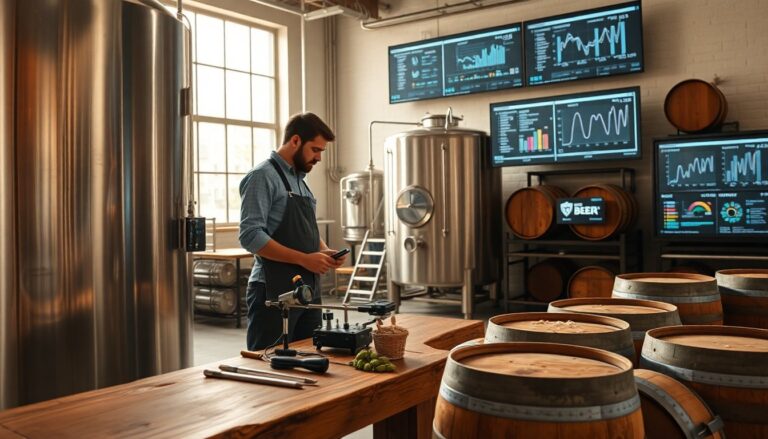
As technology advances, the brewing industry is not exempt from the influence of artificial intelligence. Recently, breweries have begun exploring how AI can streamline production processes and enhance flavor profiles. This intersection of tradition and modernity is creating a new frontier in brewing.
Celebrating its 150th anniversary, the German brewery Beck’s made headlines by introducing a new brewmaster—an AI named ChatGPT. This program was tasked with creating a beer recipe, which resulted in a lager dubbed Beck’s Autonomous. This innovative brew is said to exhibit a delightful hoppy flavor, complemented by a subtle sweetness and robust foam, leading some beer aficionados to declare it superior to existing options.
Local breweries embracing technology
In the UK, smaller breweries, such as St Austell in Cornwall, are also harnessing the power of AI. Their tropical IPA proudly claims to be “hand brewed by robots,” reflecting the collaboration between traditional methods and cutting-edge technology. Head brewer Barnaby Skerrett utilized an online generator to craft the recipe, showcasing how local establishments are experimenting with AI to push the boundaries of brewing.
Skerrett stated, “The inspiration for this beer arose from my work with AI tools in the automation of brewhouses. One day, I decided to challenge the AI by asking it to create a recipe based on different colors and flavors, and it generated some intriguing ideas that I transformed into an actual brew.”
Global trends in AI brewing
This trend is not limited to the UK; breweries worldwide are turning to AI for assistance. For example, Atwater Brewery near Detroit recently unveiled a citrus-flavored IPA developed with AI’s help. Similarly, the Japanese brewery Coedo employed generative AI to analyze consumer tastes across various demographics, resulting in a collection of beers tailored to specific age groups, which received overwhelmingly positive feedback.
The balance between tradition and innovation
Currently, the integration of AI in brewing serves as a sophisticated method for refining beer flavors. By utilizing data analysis, brewers can enhance consistency and efficiency in their processes. Ali Ross, landlady at the Coach & Horses in Soho, remarked, “We’ve been incorporating computers in brewing for some time. AI can be a valuable tool, provided it complements our skills rather than replaces them. By automating tedious tasks, we can focus on creativity.”
Concerns about the long-term implications of AI in brewing exist; however, Ross emphasizes the importance of preserving the communal aspects of pubs, which have long been essential to British culture. “Pubs are social hubs where people gather, and that essence should never be compromised,” she asserted.
As beer continues to be crafted using ancient recipes and techniques, the infusion of artificial intelligence into brewing may prove beneficial. The challenge lies in ensuring that the artistry and knowledge of traditional brewing are not overshadowed by technology. It leaves one to ponder: what might robots think of contemporary brews like Madri?