

American Football: A Dynamic Blend of Strategy, Athleticism, and Teamwork American football is an exhilarating sport that seamlessly integrates strategic thinking, physical prowess, and collaborative effort. Its unique combination of these elements captivates fans nationwide, making it one of the most popular and engaging sports in the United States.
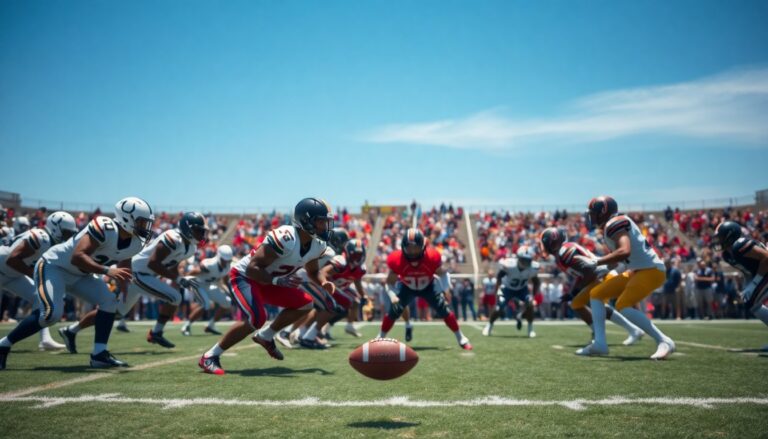
American football, commonly referred to as football in the United States and Canada, is a widely followed team sport that captivates millions of fans and players. The game involves two teams of eleven players competing on a rectangular field with goalposts at either end.
The team in possession of the oval-shaped football—known as the offense—aims to advance the ball down the field through running or passing. The opposing team, designated as the defense, seeks to stop the offense’s progress and regain control of the ball.
Success in this sport depends on strategy, teamwork, and skill.
The offense has four attempts, or downs, to advance the ball at least ten yards. If they fail, possession is turned over to the opposing team. Conversely, if they succeed, they are granted a new set of downs to continue their offensive efforts.
Points can be scored in various ways, primarily through touchdowns—achieved by reaching the opponent’s end zone—or field goals, which involve kicking the ball through the rival’s goalposts. The team with the highest score at the end of the game is declared the winner. In the event of a tie after the regulation four quarters, the game proceeds to overtime.
The genesis and evolution of American football
American football has its origins in rugby and soccer, with its first acknowledged game taking place on November 6, 1869. This landmark match featured two college teams, Rutgers and Princeton, competing under the soccer rules of that era. Initially, the game utilized a round ball and allowed up to 25 players per side, aiming primarily to kick the ball into the opponent’s goal. Rutgers emerged victorious with a score of 6 to 4.
Key developments in the sport
Throughout the late 19th century, American football underwent significant transformations, greatly influenced by Walter Camp, often regarded as the Father of American Football. His contributions in the 1880s introduced essential elements such as the snap, the concept of the line of scrimmage, and the formation of eleven-player teams. These innovations laid the groundwork for the modern game enjoyed by millions today. Camp was also instrumental in formalizing the forward pass and other key rules that shaped the sport.
A pivotal meeting of college representatives in 1873, which included institutions such as Yale and Columbia, resulted in the establishment of rules governing intercollegiate play. The adoption of a standardized set of rules marked a critical step toward transitioning from a chaotic and inconsistent style of play to a more organized game. This evolution continued with the founding of the Intercollegiate Football Association, further solidifying the sport’s identity.
The rise of American football in popular culture
Today, American football is recognized as the most popular sport in the United States. The sport encompasses various levels—professional, collegiate, and youth—boasting millions of participants. In 2025, over a million American youths participated in high school or college football programs. The National Football League (NFL), the premier professional league, has become a cultural phenomenon, with its championship game, the Super Bowl, consistently ranking among the most-watched sporting events globally.
A global perspective
While American football primarily flourishes in the United States, it is gaining traction in other regions, including Europe, Japan, and Brazil. The rise of flag football as a popular variant has further contributed to its growth, leading to its inclusion in the 2028 Summer Olympics.
The term football in the U.S. has historical roots; it was officially defined in the 1876 college football rulebook when the game began to transition from soccer-style play to a more rugby-like format. Although there was potential for the sport to be named rugby, a compromise among early advocates resulted in the designation of football as it is known today. In other English-speaking countries, the sport is often referred to as gridiron football to differentiate it from soccer.
