Explore the captivating history of the Hawker Hurricane, an essential fighter aircraft that played a pivotal role in transforming aerial combat during World War II.
Topics covered
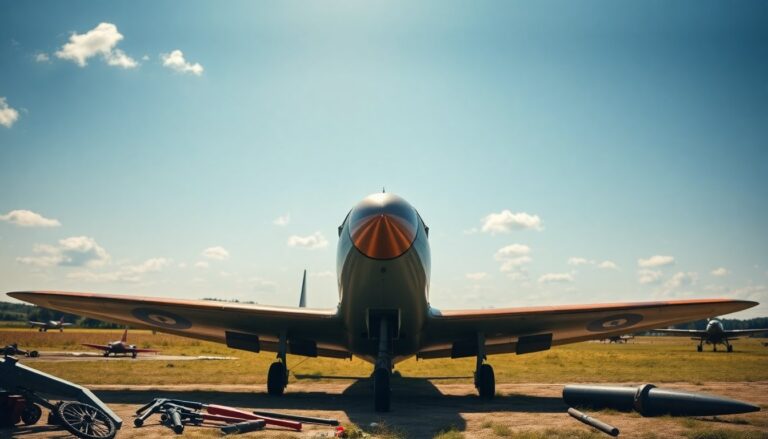
The Hawker Hurricane is a significant piece of British aviation history, having played a crucial role during the Battle of Britain. Designed in the late 1930s, this single-seat fighter aircraft was produced by Hawker Aircraft Ltd. for the Royal Air Force (RAF).
Although often overshadowed by the more renowned Supermarine Spitfire, the Hurricane proved to be a formidable opponent in the skies, inflicting substantial losses on enemy forces throughout the conflict.
The development of the Hurricane began in the early 1930s through discussions between RAF officials and pioneering designer Sir Sydney Camm.
Initial design concepts faced skepticism, as the Air Ministry preferred traditional biplanes. However, Camm persisted, refining his monoplane ideas, which ultimately led to significant advancements in military aircraft, including the introduction of retractable landing gear and the powerful Rolls-Royce Merlin engine.
The evolution of the Hawker Hurricane
By 1934, the Air Ministry issued Specification F.5/34, prompting the development of a new generation of fighter aircraft. Although Camm’s earlier designs were rejected, he adapted his concepts, resulting in the creation of the Hurricane. The aircraft’s prototype, designated K5083, made its inaugural flight on November 6, 1935, marking a significant milestone in its development.
Production and deployment
Following its successful maiden flight, the Hurricane entered production in June 1936, with the first squadrons receiving their aircraft by December 1937. Its design facilitated easier maintenance and repairs, allowing squadrons to conduct significant overhauls without extensive external assistance. As tensions in Europe escalated, the RAF quickly acquired Hurricanes, and by September 1939, 18 squadrons were equipped with the aircraft, prepared to defend against the Luftwaffe’s assaults.
Throughout its service, the Hurricane was adapted for various roles, including bomber interception and ground support. Specialized versions, such as the Sea Hurricane, featured modifications for naval operations, including an arrestor hook for carrier landings. By the end of its production run in July 1944, over 14,487 Hurricanes had been manufactured, with additional models produced in Canada and other nations.
Significant contributions to World War II
As the conflict intensified, the Hurricane became a pivotal player in numerous battles across various theatres. It was essential in achieving air superiority during the Battle of Britain, accounting for approximately 60% of the Luftwaffe’s losses. Pilots engaged in intense dogfights against the German Messerschmitt Bf 109, demonstrating the Hurricane’s agility and firepower.
Design and performance characteristics
The Hurricane’s design incorporated several innovative features that contributed to its success. With a maximum speed of 315 mph and a climb rate enabling it to reach 15,000 feet in under six minutes, the aircraft was well-equipped for intercepting enemy bombers. While the original specifications called for four machine guns, enhancements during the conflict led to the installation of up to eight guns, significantly boosting its firepower.
Despite its advantages, the Hurricane encountered challenges, particularly regarding spin recovery. Early tests indicated that under certain conditions, pilots could lose rudder authority, complicating control. This issue prompted further design modifications implemented in later production models to enhance safety and performance.
The legacy of the Hawker Hurricane
The legacy of the Hawker Hurricane extends beyond its combat performance. It symbolizes an era of rapid advancements in military aviation and the resilience of British engineering. The aircraft’s affordability and ease of production enabled the RAF to maintain a robust fleet during a critical phase of the war.
Ultimately, the Hurricane became a representation of determination and innovation, with its contributions acknowledged and celebrated long after the war concluded. Today, it remains a testament to the ingenuity of those who designed and operated it, and its story continues to inspire future generations of aviation enthusiasts.