

Huda Ammori leads a legal challenge against the UK’s classification of Palestine Action as a terrorist group, emphasizing freedom of speech.
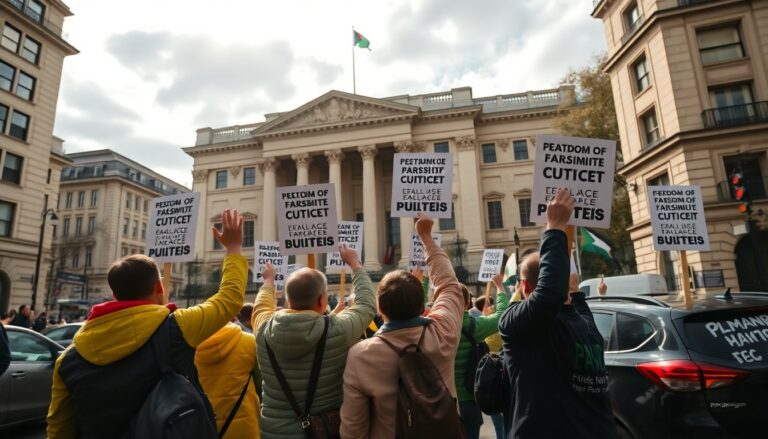
In a landmark case, Huda Ammori, co-founder of Palestine Action, is set to challenge the UK government’s designation of her group as a terrorist organization. This classification has raised significant concerns about the implications for civil liberties and the right to protest.
The High Court in London will hear the arguments starting this week, following a recent ruling from the Court of Appeal that questioned the legality of the ban.
The controversy began when Prime Minister Keir Starmer announced the ban after a series of high-profile protests and direct actions carried out by Palestine Action members.
These actions included vandalizing RAF aircraft, which activists assert were used in military operations against Palestinians in Gaza. As a result, the group has become a focal point for discussions surrounding the intersection of activism and terrorism laws in the UK.
Understanding the implications of the terror ban
The implications of labeling Palestine Action as a terrorist organization extend far beyond the group itself. The designation has serious consequences for individuals associated with the group. Since the ban, over 2,000 people have faced arrest under the Terrorism Act merely for showing support for Palestine Action, often for peacefully protesting or holding signs that advocate for Palestinian rights.
Legal framework and its criticisms
Critics argue that the UK’s Terrorism Act 2000 is excessively vague, leading to a conflation of protest activities with acts of terrorism. Legal expert Lex Korte, from the group Defend Our Juries, highlights that the term terrorism is politically charged and often misapplied to suppress dissent. He emphasizes the need for a clear distinction between legitimate protest and criminal behavior.
Moreover, the ban against Palestine Action represents a troubling precedent in British history, marking the first time a direct action group has been categorized as a terrorist organization. This raises questions about the government’s motives, particularly in light of widespread protests against the UK’s military and diplomatic support for Israel amidst ongoing conflict.
Palestine Action’s mission and actions
Established recently, Palestine Action aims to challenge the complicity of the UK arms industry in the ongoing violence in Gaza. The group employs direct action strategies to disrupt operations at facilities linked to arms production for the Israeli military. Their activities include protests, occupations, and acts of civil disobedience aimed at manufacturers like Elbit Systems, whom they accuse of contributing to war crimes.
In one notable incident, members of Palestine Action vandalized aircraft at the RAF Brize Norton base, asserting that these planes were instrumental in the bombing campaigns in Gaza. This act, while controversial, was framed by the group as a necessary response to what they view as the UK’s complicity in genocide.
Public reaction and support
The public response to Palestine Action’s activities has been mixed. Supporters commend their bold approach and commitment to highlighting the plight of Palestinians, while detractors criticize their methods as overly confrontational. However, the legal challenge spearheaded by Ammori has galvanized many, igniting debates about freedom of expression and the right to protest in the UK.
As the court hearings unfold, the outcome could set a significant precedent for how activist groups are treated under the law. If Ammori’s challenge is successful, it could lead to the lifting of the ban, allowing Palestine Action to continue its advocacy without the looming threat of criminalization.
Looking ahead: The future of Palestine Action
Looking forward, Ammori remains steadfast in her commitment to fighting the ban. She asserts that the government’s actions are intended to silence dissent and protect the interests of the arms industry rather than safeguard the public. With a growing wave of support from activists, legal experts, and human rights organizations, the fight against the terror ban has become a symbol of resistance against authoritarian measures.
The next hearings in this case are scheduled, promising to draw significant public attention and debate. As more individuals rally around the cause, the implications of this legal battle extend far beyond Palestine Action, touching on fundamental questions of justice, freedom, and the power of the state in matters of public dissent.
