

Summary of Leadership Goals in Syria Under the leadership of President al-Sharaa, Syria is committed to promoting peace and stability in the region, even amidst ongoing military actions from Israel. The administration focuses on diplomatic efforts and initiatives to strengthen national security and foster a peaceful coexistence.
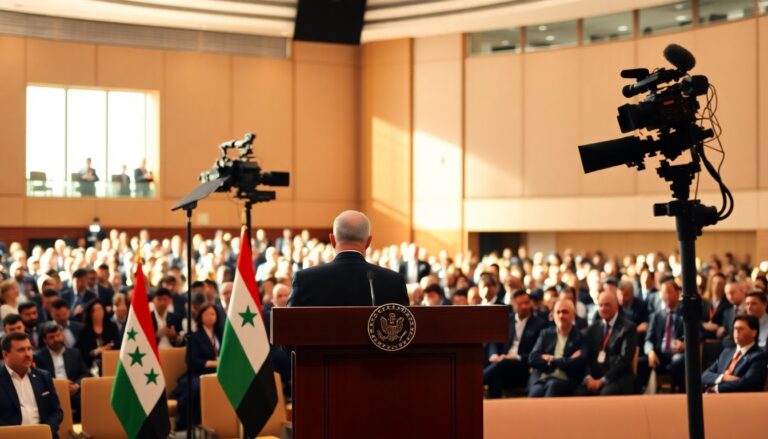
In a recent interview, President Ahmed al-Sharaa of Syria condemned Israeli military actions, which he asserts are driven by fabricated threats. As tensions escalate in the region, al-Sharaa emphasized his commitment to national unity and the significance of upcoming elections aimed at restoring stability within Syria.
During a conversation with CNN’s Christiane Amanpour at the Doha Forum, al-Sharaa characterized Israel’s actions as a distraction from its “horrifying massacres” in Gaza. He claimed that Israeli leadership frequently seeks to “export crises” to neighboring countries, using security concerns to justify military interventions.
Allegations of Israeli aggression
Al-Sharaa noted that since the regime of Bashar al-Assad collapsed in December, Israel has exhibited increased aggression, conducting air strikes across Syrian territories and causing numerous civilian casualties. Last month, Israeli forces reportedly killed at least 13 individuals in Beit Jinn, a town near Damascus.
Additionally, Israel has established multiple checkpoints within Syria and has been accused of unlawfully detaining Syrian citizens. Al-Sharaa asserted that his administration has made significant efforts to de-escalate tensions, stating they have communicated positive messages regarding peace and stability in the region.
Calls for adherence to historical agreements
Emphasizing the significance of the 1974 Disengagement Accord, established to maintain peace after the 1973 Yom Kippur War, al-Sharaa urged Israel to revert to its previous positions prior to al-Assad’s fall. He cautioned against replacing this agreement with new arrangements, arguing that such actions could jeopardize regional stability.
“This agreement has stood for over 50 years,” he declared, highlighting the risks of creating new buffer zones that may lack effective monitoring. Al-Sharaa expressed concerns about who would maintain security in these zones, given Israel’s apprehensions about potential attacks from southern Syria.
Efforts toward national unity and governance
On the issue of national unity, al-Sharaa acknowledged Syria’s challenges but expressed optimism about the country’s future. He stated, “I believe Syria is living through its best days,” emphasizing the necessity for a collective understanding among its diverse communities.
Al-Sharaa indicated that reconciliation efforts have been crucial, noting his administration’s decision to grant pardons to various factions to foster a secure future for the Syrian populace. He rejected the notion that the uprising against al-Assad was solely a Sunni revolution, asserting that all segments of Syrian society participated in the movement.
Addressing sectarian violence
Despite progress, Syria has experienced instances of sectarian violence, particularly earlier this year when conflicts erupted in coastal areas, resulting in significant casualties among the Alawite community. Al-Sharaa acknowledged these issues, stating, “We do not accept what happened,” but emphasized that the rule of law is foundational for protecting all citizens’ rights.
Concerns have been raised about the treatment of women under the new government, especially considering past restrictions imposed in regions like Idlib. However, al-Sharaa claimed that women’s rights are safeguarded under his administration, stating, “Their rights are protected and guaranteed.” He humorously added, “You should not fear for Syrian women, fear for Syrian men.”
Future electoral commitments
During a conversation with CNN’s Christiane Amanpour at the Doha Forum, al-Sharaa characterized Israel’s actions as a distraction from its “horrifying massacres” in Gaza. He claimed that Israeli leadership frequently seeks to “export crises” to neighboring countries, using security concerns to justify military interventions.0
During a conversation with CNN’s Christiane Amanpour at the Doha Forum, al-Sharaa characterized Israel’s actions as a distraction from its “horrifying massacres” in Gaza. He claimed that Israeli leadership frequently seeks to “export crises” to neighboring countries, using security concerns to justify military interventions.1
