Margaret Atwood Highlights the Timely Relevance of The Handmaid's Tale Amidst Current Events
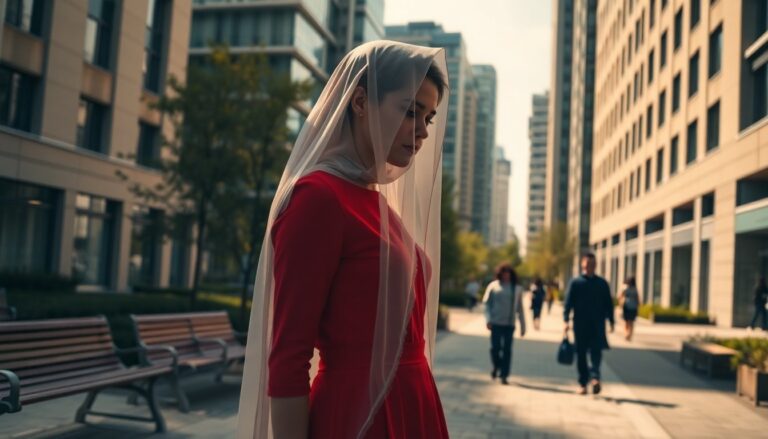
Renowned author Margaret Atwood has indicated that the themes presented in her acclaimed novel The Handmaid’s Tale increasingly reflect modern-day realities. Since its initial release in 1985, this powerful narrative has resonated with countless readers and has been adapted into a successful television series, further solidifying its place in contemporary culture.
In an interview on BBC Radio 4’s Desert Island Discs, Atwood discussed the evolution of her work and the unsettling parallels between its fictional dystopia and current societal issues. The novel depicts a totalitarian regime where women’s rights are severely curtailed—a scenario that Atwood previously considered implausible.
The evidence
Atwood’s narrative centers around a theocratic dictatorship known as the Republic of Gilead, which emerged following a societal collapse. Women, particularly those deemed fertile, are forced into servitude as handmaids, obliged to bear children for the elite ruling class.
Atwood’s original perception of the plot as far-fetched has drastically shifted over the years.
Atwood recalled that when she conceived the idea for the book, America was seen as a symbol of freedom and democracy. She noted, “At that time, America was perceived as a beacon of hope, a land where democratic ideals thrived, leading many to dismiss the notion that such a regime could ever take root there.” However, she acknowledged that this perspective has changed significantly, prompting her to reflect on how quickly reality can shift.
The reconstruction
Atwood observed that initial reactions to her novel were mixed, with many asserting that the events described could never occur in their societies. Nevertheless, she has maintained that totalitarian regimes can develop under the right conditions, regardless of location. “I’ve always believed that it can happen anywhere, given the right circumstances,” she stated.
Reflecting on the book’s enduring significance, Atwood emphasized the political landscape changes of 2016, noting that the themes explored in The Handmaid’s Tale have grown alarmingly relevant. She remarked, “Although we might not see the exact attire described in the book—red cloaks and white bonnets—the underlying issues are becoming increasingly plausible.”
Key players
The distinctive attire of the handmaids symbolizes their roles as childbearers in a society that views them merely as vessels. The red cloaks signify their purpose, while the white bonnets restrict their vision, representing their oppression. This imagery has inspired numerous protests, particularly during the Trump administration, where women donned similar outfits to voice their dissent against policies threatening reproductive rights.
Atwood’s exploration of these themes extends beyond fiction; it serves as a cautionary tale about the fragility of freedoms. She highlighted that oppressive regimes often falter due to their inherent unsustainability. “Such systems ultimately collapse under their own weight, especially when they become chaotic,” she added.
The implications
Despite the grim circumstances depicted in her works, Atwood remains optimistic about the resilience of the American spirit. She asserts that the United States is far more diverse than it may appear from an external viewpoint and that its citizens possess a strong aversion to being controlled by any authority. “Americans have a unique spirit; they resist being told to fall in line, regardless of whether the direction comes from the left or right,” she explained.
Atwood’s literary contributions address a wide array of important topics, including technology and identity. She has frequently clarified that her work belongs to the realm of speculative fiction, which she defines as narratives grounded in possibilities rather than the fantastical elements typical of science fiction. “The events I portray are drawn from historical realities; they are reflections of the human experience, not mere figments of imagination,” she stated in response to critics questioning her narrative choices.
What happens next
In an interview on BBC Radio 4’s Desert Island Discs, Atwood discussed the evolution of her work and the unsettling parallels between its fictional dystopia and current societal issues. The novel depicts a totalitarian regime where women’s rights are severely curtailed—a scenario that Atwood previously considered implausible.0
In an interview on BBC Radio 4’s Desert Island Discs, Atwood discussed the evolution of her work and the unsettling parallels between its fictional dystopia and current societal issues. The novel depicts a totalitarian regime where women’s rights are severely curtailed—a scenario that Atwood previously considered implausible.1