

Recent Arrests During London Protests Highlight Police's Shift on Controversial Slogans In recent demonstrations across London, police have adopted a firmer approach regarding the use of controversial slogans, leading to a series of arrests. This shift in law enforcement strategy reflects changing dynamics in public protests and raises questions about freedom of expression and police authority. As tensions between demonstrators and law enforcement escalate, the implications for future...
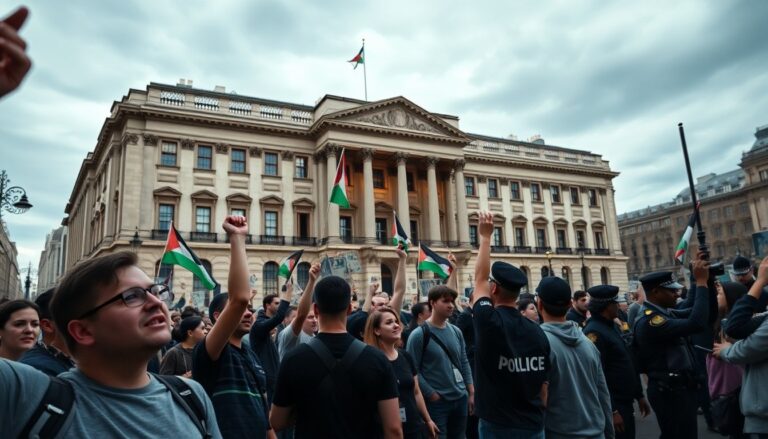
In a significant change to law enforcement practices, the Metropolitan Police and Greater Manchester Police have started arresting individuals who chant slogans related to intifada during public demonstrations. This shift was highlighted following a protest outside the Ministry of Justice in Westminster, London, where two individuals were arrested for advocating for an intifada, or uprising.
The police action follows a rise in tensions sparked by recent violent incidents, including a mass shooting at Bondi Beach in Australia and a stabbing at a synagogue in Manchester. The decision to restrict certain protest slogans indicates increasing concerns about public safety and the state of community relations.
Police response and community reactions
Pro-Palestinian protest leads to arrests in London
Approximately 100 individuals gathered during a protest, voicing pro-Palestinian sentiments. As chants for an intifada resonated through the crowd, police officers intervened. The initial arrests were followed by a third individual taken into custody for obstructing police efforts.
The Metropolitan Police confirmed that the arrests were made under racially aggravated public order offences. Chief Rabbi Sir Ephraim Mirvis expressed his support for the police action, considering it a necessary measure to combat hate speech and violent rhetoric that has become increasingly evident at protests across the UK.
Concerns over political repression
Despite endorsements from some community leaders, this crackdown has faced significant criticism from various activist groups. The Palestine Solidarity Campaign condemned the police’s actions as an infringement on the right to protest, characterizing it as political repression against advocates for Palestinian rights.
Ben Jamal, a representative from the Campaign, stated that the term intifada signifies a struggle against injustice. He emphasized that such slogans should not be misinterpreted as incitements to violence. Instead, they are intended to express solidarity with the Palestinian people in their fight for liberation.
Broader legal and social implications
The recent arrests underscore a significant shift in policing practices related to public demonstrations. Police leaders have acknowledged that earlier thresholds for prosecuting protest language are no longer sufficient in a climate where words can result in tangible consequences. The Public Order Act is being enforced more rigorously to ensure community safety, particularly in areas with substantial Jewish populations.
In a joint statement, police commissioners emphasized the need for a more proactive approach to protest language, especially following events that have heightened concerns within the Jewish community. They highlighted that community apprehensions regarding phrases like “globalise the intifada” will be taken seriously. They also warned that future protests featuring such slogans could result in similar enforcement actions.
Understanding the term ‘intifada’
The term intifada, which translates from Arabic to ‘uprising’ or ‘shaking off,’ is historically linked to resistance against military occupation. It became prominent during the Palestinian uprisings against Israeli control in the late 20th century and often symbolizes civil disobedience and calls for international support against oppression.
While some interpret the term as a call for violence, many activists argue that it embodies a peaceful struggle for rights and justice. The phrase “globalise the intifada” is viewed by supporters as an appeal for global solidarity rather than violence, though its interpretation continues to be a point of contention.
Future of protest rights and police enforcement
Police response to protest slogans raises questions about free speech
The evolving police response to protest slogans highlights the challenging balance between maintaining public order and safeguarding the right to free speech. As the UK faces these complex issues, the impact of such policies on future protests remains uncertain.
Prime Minister Sir Keir Starmer has signaled a review of public order laws following recent events, suggesting that discussions surrounding protest rights and law enforcement will likely intensify. This ongoing dialogue emphasizes the necessity for clear guidelines regarding acceptable protest behavior in a diverse society.
