

Headline: Trump Imposes Blockade on Venezuela's Oil Exports Amid Military Build-Up Summary: Tensions escalate as President Trump announces a blockade on Venezuela's oil exports, coinciding with the mobilization of military forces in the region. This strategic move aims to exert pressure on the Venezuelan government amid ongoing geopolitical conflicts. Key Points: Blockade Implementation: President Trump's decisive order to block Venezuelan oil exports. Military Forces Deployment: Increased...
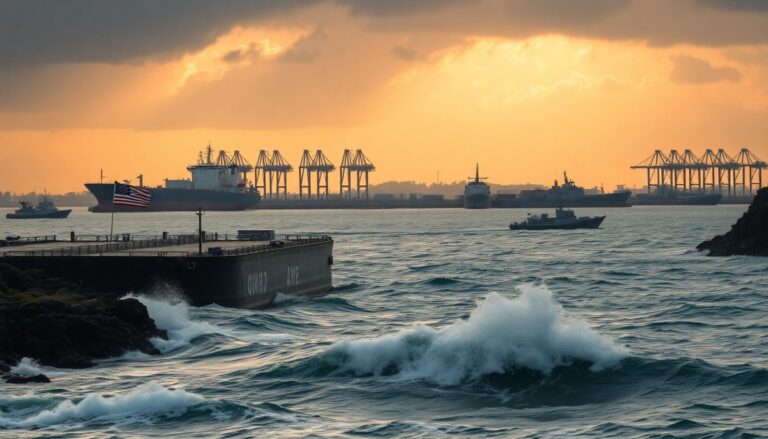
In a significant escalation of tensions, President Donald Trump has announced a comprehensive blockade on all oil tankers sanctioned by the United States, whether entering or exiting Venezuela. This directive follows a massive military buildup near the South American nation, raising concerns about a potential conflict.
The Venezuelan government, led by President Nicolás Maduro, has strongly condemned this action, describing it as a blatant attempt to seize Venezuela’s natural resources.
Context of the blockade
The blockade was announced on a social media platform by former President Donald Trump.
He stated, “Venezuela is completely surrounded by the largest Armada ever assembled in the history of South America.” The military positioning near Venezuela has been primarily justified by the United States as a measure to combat drug trafficking, terrorism, and other illicit activities.
However, critics contend that this justification serves as a pretext for a broader agenda aimed at regime change in Venezuela, a nation abundant in oil reserves.
Responses from Venezuela and international reactions
Maduro’s administration swiftly condemned Trump’s blockade, labeling it a “grotesque threat” aimed at stealing the nation’s wealth. He asserted that the world would unite against what he described as “piracy” and “oil plunder.” This statement followed the US seizure of the Venezuelan oil tanker, the Skipper, which was taken off the coast and transported to Texas.
The situation has garnered international attention. The Russian Foreign Ministry cautioned that escalating tensions might lead to unpredictable consequences for the West. This concern highlights a growing apprehension regarding US military actions in a region already marked by geopolitical strife.
Impact on the Venezuelan economy
The blockade is poised to significantly pressure President Nicolás Maduro’s regime, which depends heavily on oil exports for economic stability. Sanctioned vessels have traditionally been crucial in sustaining Maduro’s patronage system by participating in a global black market for oil. With the United States effectively severing this vital supply line, the Venezuelan economy, already grappling with severe sanctions, faces heightened instability.
In the wake of the seizure of the Skipper, Venezuelan crude exports have dramatically decreased, directly affecting the regime’s revenue. Reports reveal that out of eighty ships in Venezuelan waters, over thirty are currently under U.S. sanctions, highlighting the blockade’s potential to devastate the illicit trade essential for Venezuela’s economy.
Future implications of the blockade
The blockade’s strategic implications are significant. By restricting access to oil exports, the United States gains a crucial leverage point in negotiations aimed at ending Nicolás Maduro’s rule. This situation elevates the Caribbean campaign from a counter-drug operation to a direct challenge to the financial foundations of the Venezuelan regime, which the US has designated as a foreign terrorist organization.
Experts warn that if the blockade continues, the Venezuelan economy could suffer catastrophic consequences, potentially escalating instability in the region. Additionally, the blockade may disrupt not only Venezuelan oil exports but also those from other nations, such as Iran, engaged in similar illicit trade practices.
Market reactions and global implications
The global oil market has demonstrated resilience despite the ongoing blockade. Prices have only seen modest increases, suggesting that the market might have anticipated higher levels of US naval intervention. Current oil pricing dynamics are shaped by various factors, including supply chain adaptations and existing reserves. This indicates a complex interaction between sanctions and market responses.
As the US proceeds with its blockade strategy, it is essential to observe how the enforcement of sanctions evolves, especially regarding digital assets. Venezuela has been known to accept payment for its oil in stablecoins to circumvent traditional financial systems. This presents an additional layer of complexity in the ongoing economic confrontation.
The blockade imposed by former President Trump on Venezuelan oil tankers is more than just a tactical move; it represents a significant confrontation with wide-ranging implications for both regional stability and global energy markets. As the situation develops, the international community remains attentive, recognizing that the consequences will likely reach far beyond Venezuela’s borders.
