

Global Leaders React to Trump's Tariff Threats Regarding Greenland In a significant geopolitical development, global leaders have expressed strong reactions to President Trump's recent tariff threats concerning Greenland. The implications of these threats have sparked widespread discussions among international policymakers, economists, and trade experts, highlighting the potential impact on global trade relations and diplomatic ties. As nations assess the ramifications of these tariffs, key...
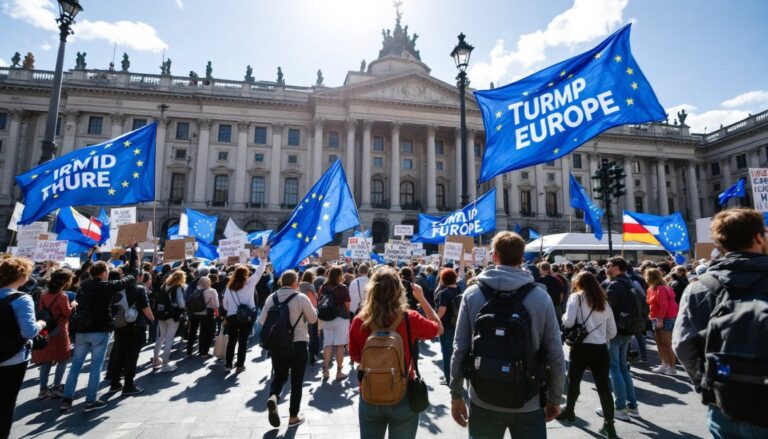
Trump’s tariff announcement sparks European backlash
In a surprising move, U.S. President Donald Trump has announced plans to impose tariffs on several European nations, including the United Kingdom. This decision is part of a controversial strategy aimed at acquiring Greenland from Denmark.
The announcement has ignited widespread criticism from various leaders across Europe, who view the tariffs as an unjust tactic against allies.
Details of Trump’s tariff proposal
The proposal includes a 10% tariff on all goods exported from Denmark, Norway, Sweden, France, Germany, the UK, the Netherlands, and Finland, effective February 1.
This rate is set to escalate to 25% by June 1 if an agreement regarding the purchase of Greenland remains elusive. In his statements, Trump characterized the situation as a matter of national security, emphasizing that countries involved in discussions about Greenland have engaged in a “dangerous game” that threatens global stability.
Reactions from European leaders
Prime Minister Sir Keir Starmer of the UK expressed his strong disapproval of the situation, labeling Trump’s actions as “completely wrong.” He affirmed that the future of Greenland should be determined by the Danish and Greenlandic people, highlighting that Arctic security is a shared concern among NATO allies. Starmer stated, “We will pursue this issue directly with the U.S. administration.”
French President Emmanuel Macron also condemned the tariff threats, deeming them “unacceptable.” He confirmed that European nations are coordinating a unified response to the situation, focusing on maintaining solidarity with Denmark. Other leaders, including Ulf Kristersson of Sweden and Petteri Orpo of Finland, reiterated their support for Denmark, asserting that tariffs should not feature in discussions regarding Greenland.
The impact of tariffs on transatlantic relations
The European Commission and Council leaders, Ursula von der Leyen and Antonio Costa, have expressed serious concerns regarding the potential imposition of tariffs. They warned that such measures could trigger a “dangerous downward spiral” in relations between Europe and the United States. This escalation would risk undermining the historically strong ties that connect NATO allies.
Emphasizing a commitment to diplomacy, the EU leaders insisted that dialogue remains essential for resolving conflicts. They believe that open communication is crucial to maintaining stability in transatlantic relations amidst rising tensions.
Military presence and Arctic security
In response to escalating tensions, Denmark has increased its military presence in Greenland and is collaborating with allies to enhance Arctic security. The United Kingdom recently dispatched a military officer to join a reconnaissance team. The government clarified that this action is a precautionary measure, not a deployment. Denmark’s defense strategy aligns with NATO principles, emphasizing the significance of collective security in the Arctic, particularly in light of perceived threats from Russia and China.
Comments made by former U.S. President Donald Trump have raised concerns among global leaders, who fear his approach could embolden adversaries. Former Estonian Prime Minister Kaja Kallas underscored the necessity of unity among allies, stating that “China and Russia must be having a field day,” benefiting from divisions within NATO. Kallas argued that security concerns regarding Greenland should be addressed within the NATO framework, rather than through economic sanctions that could undermine shared prosperity.
Public sentiment and protests
Public sentiment in Greenland and Denmark has reflected widespread discontent regarding former President Donald Trump’s tariff threats. Demonstrations have erupted in the capital of Greenland, Nuuk, and across Denmark. Protesters have advocated for self-governance while opposing any potential U.S. takeover. Many waved flags and held signs with slogans such as “Hands off Greenland,” emphasizing the territory’s right to self-determination.
The backlash against Trump’s tariffs highlights broader concerns about his administration’s approach to international relations. UK politicians, including Tory leader Kemi Badenoch and Liberal Democrat leader Sir Ed Davey, have expressed apprehensions regarding the economic repercussions of these tariffs, arguing they would impose significant burdens on British businesses and the economy.
As discussions continue among European leaders and within NATO, addressing the Greenland issue remains critical. The call for collaboration and solidarity among allies resonates strongly as they navigate this complex geopolitical landscape.
