

An overview of the newly formed Board of Peace in Gaza under Trump's administration.
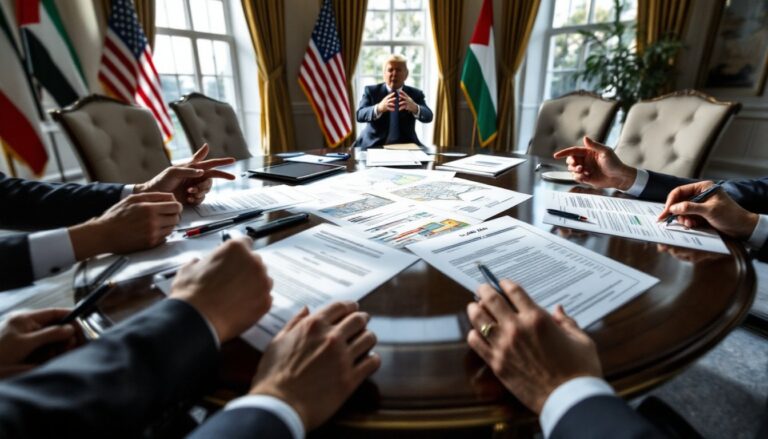
In a significant move, President Donald Trump has unveiled the structure of the Board of Peace, a pivotal body designed to implement his ambitious 20-point plan aimed at stabilizing Gaza. This announcement comes shortly after the U.S. envoy, Steve Witkoff, initiated the second phase of the U.S.-mediated strategy to address the ongoing conflict in Gaza, which has resulted in severe humanitarian crises.
The White House’s declaration outlines a hierarchical framework that places a group of billionaires and influential figures closely aligned with Israel at the pinnacle of decision-making. This configuration raises concerns about the exclusion of Palestinians from crucial governance discussions.
The hierarchical structure of the Board of Peace
At the top of the governance pyramid lies the Founding Executive Council, which holds substantial power over funding and strategic direction. President Trump himself chairs this elite body, retaining the authority to veto decisions.
The composition of this council includes key figures such as:
- Marco Rubio, U.S. Secretary of State, known for his staunch pro-Israel stance.
- Steve Witkoff, the U.S. Special Envoy with a controversial background in Gaza negotiations.
- Jared Kushner, Trump’s son-in-law, who has previously questioned Palestinian governance capabilities.
- Marc Rowan, billionaire co-founder of Apollo Global Management.
- Ajay Banga, President of the World Bank, nominated by Trump.
- Tony Blair, former British Prime Minister, whose involvement is viewed with skepticism.
This council’s decisions are expected to shape the future of Gaza, yet the absence of Palestinian representation raises alarms regarding the legitimacy and fairness of the governance structure.
Concerns about governance and representation
The second tier of the governance model is the Gaza Executive Board, which is tasked with operational coordination. This board includes members such as:
- Turkish Foreign Minister Hakan Fidan
- Qatari diplomat Ali Al-Thawadi
- UAE Minister of State for International Cooperation Reem Al-Hashimy
Despite its diverse representation, this board’s mandate to support governance in Gaza is seen by some as merely a facade. Critics argue that the creation of such a structure effectively marginalizes Palestinian voices and reduces them to mere service providers within their own territories.
International implications and regional reactions
As the Board of Peace begins to take shape, various international leaders have been invited to participate, including those from Egypt, Turkey, and Jordan. This inclusion signifies an attempt to gather regional support for the initiative. However, Israeli officials have voiced strong objections, particularly to the involvement of Turkish and Qatari representatives, viewing it as a threat to their security and stability.
Israeli Prime Minister Benjamin Netanyahu has expressed discontent, suggesting that the establishment of this board was not adequately coordinated with Israel. Some Israeli officials advocate for a more aggressive approach, arguing against any governance structure that includes nations perceived as sympathetic to Hamas.
The Palestinian perspective
Within Gaza, opinions on the Board of Peace are mixed. While some residents recognize the potential for improvement in daily life, others view the arrangement as an assault on their national sovereignty. Critics, such as political analyst Iyad al-Qarra, highlight the commercial nature of the governance model, likening it to a corporate takeover rather than a legitimate political solution. Al-Qarra states, “This structure represents a shift in decision-making power to investors and foreign politicians, treating Gaza not as a homeland but as a business entity in distress.”
Furthermore, the National Committee for the Administration of Gaza (NCAG), which serves at the lowest tier of this system, consists of professionals tasked with managing local governance. However, their authority is limited, as they operate under the oversight of the High Representative appointed by the Board of Peace.
Conclusion: A contested path forward
The formation of the Board of Peace has initiated a complex dialogue surrounding the future governance of Gaza. While the U.S. portrays this initiative as a pathway to stability and prosperity, the exclusion of Palestinian voices raises critical questions about its effectiveness and legitimacy. As the situation evolves, the true impact of this board will depend on its ability to address the underlying issues of governance, representation, and sovereignty while navigating the intricate political landscape of the region.
