

Headline: US Approves Arms Sale to Israel Amid Ongoing Gaza Tensions Summary: The United States has authorized a significant arms sale to Israel, a move that has sparked debate regarding its potential ramifications on regional stability and the escalating situation in Gaza. Key Points: Arms Sale Approval: The US government has officially sanctioned a controversial arms deal with Israel, emphasizing its commitment to supporting its ally amid rising tensions. Regional Impact: This arms sale...
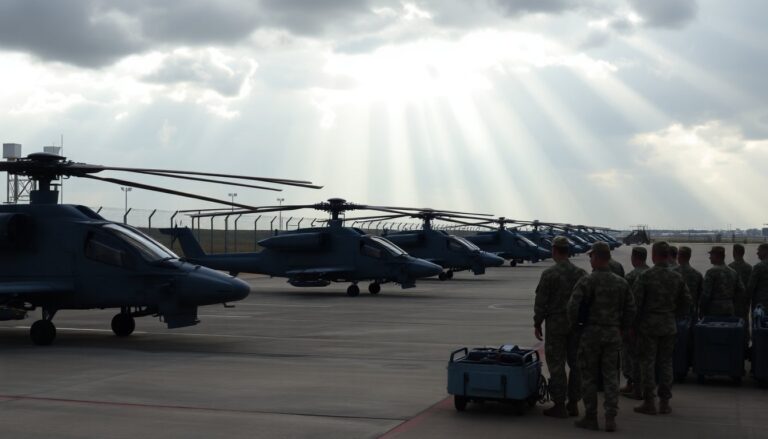
In a significant development, the United States government has authorized a $6.67 billion arms sale to Israel, which includes the acquisition of 30 Apache helicopters. This decision arises during a tenuous ceasefire in the ongoing conflict in the Gaza Strip, where tensions remain high, and violence has resulted in numerous civilian casualties.
The ramifications of this military support are extensive, raising both political and humanitarian concerns as the region copes with the consequences of the conflict.
According to the US Department of State, the agreement encompasses not only the helicopters but also infantry assault vehicles valued at approximately $1.98 billion.
Additionally, a separate contract for military equipment worth $740 million has been approved, along with $150 million allocated for light utility helicopters. This comprehensive military aid has drawn increased scrutiny from various human rights organizations and international observers.
The humanitarian crisis in Gaza
The ongoing conflict has precipitated a catastrophic humanitarian situation in Gaza, with reports indicating that at least 71,662 individuals have perished since hostilities escalated in. This staggering figure underscores the dire circumstances faced by the Palestinian population amid continuous military operations. The deployment of Apache helicopters by Israeli forces has sparked particular controversy, as these aircraft have been utilized in attacks on civilian areas.
International response and criticism
Human rights groups and experts from the United Nations have persistently urged the US to suspend its military shipments to Israel. They contend that such arms deals exacerbate the ongoing violence and the humanitarian crisis in Gaza. The UN and various advocacy organizations have emphasized the necessity of reevaluating military aid policies, highlighting the importance of prioritizing human rights and civilian safety.
Despite the fragile ceasefire established on October 10, 2026, hostilities have persisted, with Israeli forces conducting operations that have resulted in further casualties. Reports indicate that nearly 500 Palestinians have died since the ceasefire was declared, undermining efforts for peace in the region.
The geopolitical implications
This arms sale is not an isolated incident; it is part of a broader strategy concerning US foreign policy in the Middle East. The State Department has stated that supporting Israel’s military capabilities is viewed as a vital interest for the US, asserting that a strong Israel contributes to regional stability. However, this viewpoint is not universally accepted, as many perceive it as a factor contributing to ongoing tensions.
Saudi Arabia’s military deal
In conjunction with the arms sale to Israel, the US also announced a $9 billion deal with Saudi Arabia for 730 Patriot missiles and related defense systems. This transaction aims to enhance Saudi Arabia’s defensive capabilities against potential threats, particularly from Iran. Such military agreements reflect the intricate relationships and power dynamics within the region.
Furthermore, Saudi Crown Prince Mohammed bin Salman has publicly declared that the kingdom will not allow its airspace to be used for military actions against Iran. This statement, amidst an increasing US military presence in the region, highlights the delicate balance of power and the potential for conflict escalation.
As the situation evolves, the implications of US arms sales to both Israel and Saudi Arabia are likely to significantly influence the geopolitical landscape. Stakeholders on all sides of the conflict are closely monitoring these developments, as they could reshape alliances and impact the ongoing struggles faced by civilians caught in the crossfire.
