An Edinburgh planning decision cleared the way for 13 serviced apartments in a former Leith bank, while the Ayr Jewish community’s history is traced from its early addresses to its mid-1970s closure
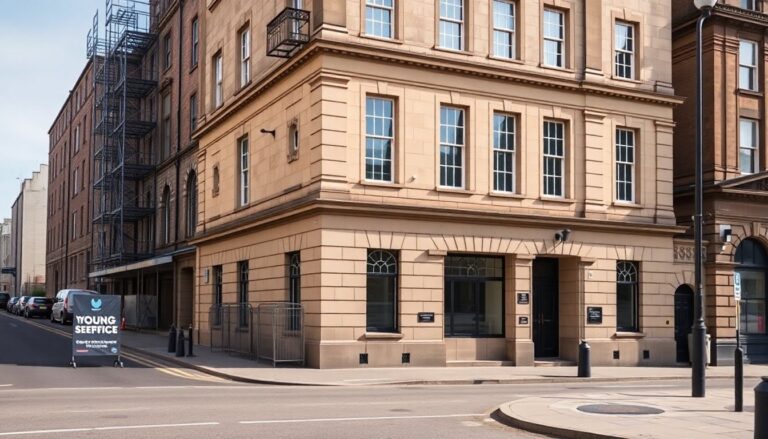
Leith bank to become 13 serviced apartments as small congregations evolve in southwest Scotland
Edinburgh councillors have granted permission to convert a vacant bank in Leith into 13 serviced apartments, clearing the way for refurbishment of the old financial premises.
The plan keeps much of the building’s exterior and adapts the interior for short‑stay occupancy — a reuse approach that sidesteps demolition and its carbon cost.
What the decision changes on the ground
The council’s approval covers the change of use to serviced accommodation and includes conditions aimed at protecting local character and managing impacts such as noise, parking and turnover.
Developers argue the scheme will bring footfall back to a quiet stretch of town centre and offer a flexible residential product that suits visitors and transient workers. Neighbours and housing advocates, meanwhile, worry about pressure on long‑term housing availability and changes to the area’s feel; the conditions attached to the consent are meant to limit those risks.
Environmentally, reworking the existing envelope scores well against demolish‑and‑rebuild alternatives: retaining masonry and structural fabric cuts embodied carbon and saves materials. Practically, the next steps will be detailed surveys, building‑control compliance, securing a short‑term‑let licence and a traffic/amenity management plan. Developers who foreground circular design, thorough stakeholder engagement and clear management arrangements tend to smooth both the planning and operational paths — the Leith scheme will likely follow that playbook.
Ayr’s Jewish community: a concise history
Ayr’s Jewish presence was always modest but active. The Ayr Hebrew Congregation formalised in 1902 and, over the decades, worship and community life moved around town — records list premises on Kyle Street, the High Street and later Sandgate. In the postwar period the congregation made use of the Invercloy Hotel on Racecourse Road, which doubled as hostel accommodation and a place for services through the 1950s and into the 1960s.
The congregation supported the kinds of social structures you’d expect in a small community: a Zionist society, a ladies’ circle, debating groups and local branches of national Jewish organisations. Ministers and lay readers named in directories — notably Rev. Hyman Davies and Rev. Samuel Knopp — provided services, education and pastoral care, often moving between provincial posts and larger centres.
Why the community faded
Like many small provincial congregations, Ayr’s population dwindled after mid‑century. Postwar migration patterns, changing employment opportunities and the rising cost of maintaining buildings all played a part. The wartime years had brought a temporary influx of evacuees and refugees, and festival services were sometimes so full they spilt into other halls. But by the 1950s and ’60s numbers were slipping; by 1970 the community was largely an administrative listing and, in the mid‑1970s, it was recorded as having ceased. The Invercloy — once advertised as Scotland’s only kosher hotel — was let or transferred as the congregation’s needs changed.
People and traces that remain
Although the congregation no longer meets, its footprint survives in archives, directories and local memory. There is no dedicated Jewish cemetery in Ayr, but yearbooks, press cuttings and council records preserve names of presidents, treasurers and volunteers who ran communal life. Aside from clerical figures, a few individuals with Ayr connections appear in wider public life: wrestler Noam Dar grew up in the town; Harold Levy, a noted Hebrew teacher, was born there; and Oscar Slater’s long and controversial legal story touches Ayr’s social history.
Practical lessons for planners and heritage stewards
Both the Leith conversion and the Ayr story point to practical, repeatable steps for balancing reuse, heritage and community value:
- – Start with a condition survey and a proportionate life‑cycle assessment to quantify embodied‑carbon savings from reuse.
- Map emissions and operational implications, and spell out management arrangements for short‑stay properties.
- Engage early with local interest groups, heritage bodies and any remaining community stakeholders to surface sensitivities and design mitigations.
- Catalogue and digitise surviving records, and promote accessible displays or exhibits so history informs future change.
These measures preserve memory while helping developers and councils make better, more inclusive decisions about how buildings are reused.
Edinburgh councillors have granted permission to convert a vacant bank in Leith into 13 serviced apartments, clearing the way for refurbishment of the old financial premises. The plan keeps much of the building’s exterior and adapts the interior for short‑stay occupancy — a reuse approach that sidesteps demolition and its carbon cost.0
Edinburgh councillors have granted permission to convert a vacant bank in Leith into 13 serviced apartments, clearing the way for refurbishment of the old financial premises. The plan keeps much of the building’s exterior and adapts the interior for short‑stay occupancy — a reuse approach that sidesteps demolition and its carbon cost.1