A 60-person inflatable drifts across the Channel under French and British watch as smugglers shift launch points westward.
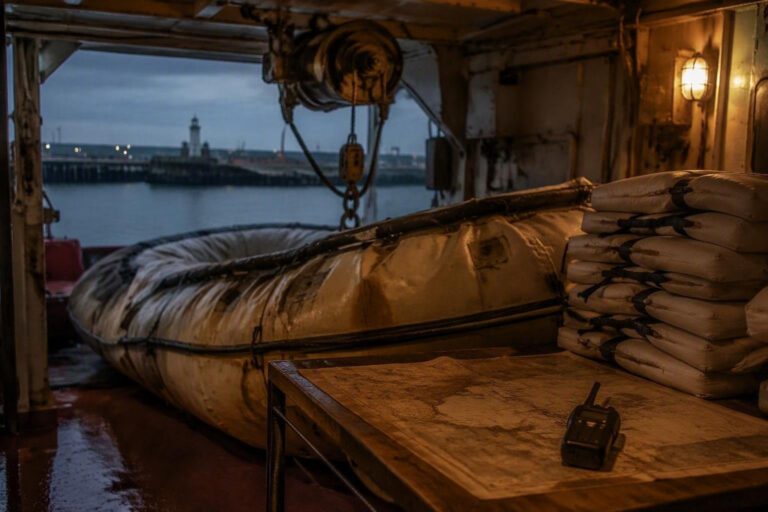
Early on Monday, a huge inflatable vessel departed from Port-en-Bessin, a small harbour near Bayeux, carrying an estimated fifty people. Later that evening, eleven more migrants climbed aboard at Cote Fleurie, a spot thirty miles to the east, bringing the total to more than sixty souls cramped into a single dinghy.
The French maritime prefecture immediately ordered a full escort: four lifeboats from the Société Nationale de Sauvetage en Mer (France’s equivalent to the RNLI) and the tug Abeille Liberté were dispatched to shadow the craft as it entered the heart of the English Channel.
By the time the clock struck 24 hours, the inflatable was still adrift in the central Channel, with the French tug following closely behind. Two RNLI lifeboats from Hastings and Eastbourne were launched just after 11 am, positioning themselves to meet the vessel if required.
A spokesman for the French maritime prefecture explained the operation, stating, “This dinghy is monitored by assets coordinated by MRCC Gris-Nez within its search and rescue region, as part of its search and rescue mission and in response to the obligations of international law and the law of the sea.” The RNLI confirmed that its crews were acting at the request of HM Coastguard, despite recent abuse directed at volunteers who have rescued migrants.
Why the western departure matters
Launching from Port-en-Bessin means the journey to Britain spans roughly 160 miles from Calais and 180 miles from Dunkirk, far longer than the traditional routes used by smugglers. French officials note that the distance is “as much as 100 miles, four times that from Dover to Calais,” which forces a larger, sturdier vessel and a more extensive escort. Local rescue officials described the dinghy as “in a very bad way, and very low in the water, with just a single small outboard motor to power it.” Although the sea was calm and weather favourable, authorities chose to monitor rather than intervene directly.
The shift westward reflects smugglers’ attempts to evade increased surveillance along the classic crossing points of Calais and Dunkirk. Earlier this month, a 46-foot “mega-dinghy” carrying 140 migrants left a Normandy launch site near Utah Beach – the historic D-Day landing zone – and completed a 70-mile crossing in about 14 hours, prompting a massive police presence on the British shore. Those incidents demonstrate a growing trend: operators are consolidating passengers onto larger crafts, sometimes capable of holding more than one hundred people, and charging roughly £2,000 per head.
Political reactions and security response
Hard-right activist Daniel Thomas, known online as “Danny Tommo” and linked to Tommy Robinson, announced he would sail into the Channel to track the vessel, livestreaming his high-speed boat and promising to “document that handover.” He framed the effort as “Portsmouth 2.0,” echoing earlier clashes between masked activists and police when a 140-person dinghy was escorted into Portsmouth.
On the official side, Defence Minister Luke Pollard dismissed claims that the government had lost control of the border, declaring, “Our borders are secure, but we want to make them stronger.” He stressed that a Home Office investigation was under way to determine how the craft slipped past existing safeguards. Pollard added that
French authorities also reported a “significant” rise in departures from the north-west coast, with most migrants originating from Sudan, Syria, Kurdistan and Iraq. In response, French police have begun actively disabling smaller boats—slashing hulls and removing outboard motors—to choke the supply chain that fuels the crossings.
The episode underscores a widening gap between enforcement tactics and smugglers’ adaptive strategies. While traditional launch points are being cracked down upon, the emergence of “mega-dinghies” from remote Normandy beaches forces both French and British rescue services to allocate additional assets across a broader stretch of the Channel. As the season progresses, the coordination between the French maritime prefecture, the RNLI, and HM Coastguard will likely remain at the forefront of the humanitarian-security balance.