

Trump’s red‑carpet welcome for Xi dazzles, but the summit delivers only a short trade‑truce and a panda shipment.
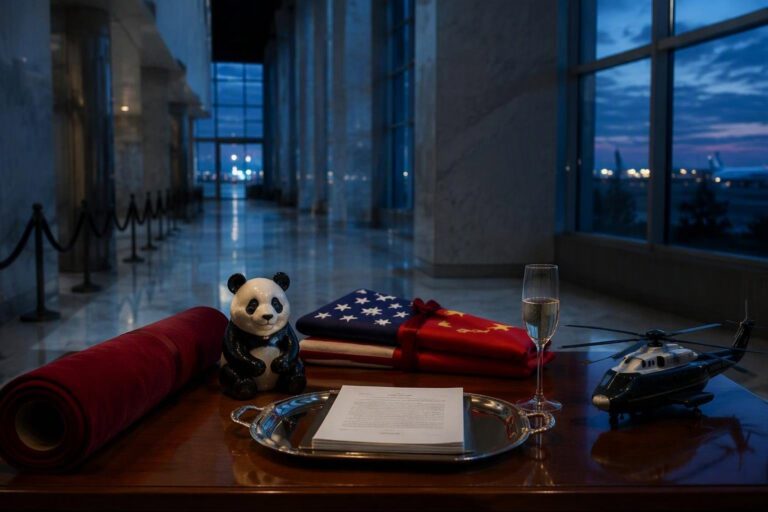
President Donald Trump rolled out a red carpet for Chinese leader Xi Jinping at Joint Base Andrews on Wednesday, marking the start of a three-day state visit that blended pageantry with a few diplomatic footnotes. The itinerary featured a tour of the new Marine One helipad, a 90-minute private meeting, and the announcement that two giant pandas would travel to the Atlanta Zoo later this year.
While the visual spectacle – from the presidential aircraft to the fireworks-filled welcome – dominated headlines, analysts quickly noted the lack of concrete breakthroughs.
Trade war fatigue and a fleeting truce
The most tangible outcome of the encounter was an agreement to extend the existing trade truce for an additional two months, pushing its expiry from November to the end of January 2029.
The original tariffs, launched by Trump in 2022, had shaved the U.S. trade deficit with China from nearly $300 billion in 2024 to about $200 billion in 2025, but the reduction was partially offset by Chinese goods rerouted through third-country ports.
Beijing’s response to the tariff pressure – a suspension of rare earths exports, minerals crucial for U.S. defense and clean-energy supply chains – has limited Washington’s leverage and forced a modest diplomatic concession.
Political symbolism, Taiwan and the Thucydides trap
Beyond economics, Xi used the visit to press Washington on the most sensitive geopolitical flashpoint: Taiwan. In a private briefing, he urged the United States to adopt the “correct position of opposing Taiwan independence,” a phrasing that would shift U.S. policy from a neutral stance to an explicit opposition. The request coincided with a pending $14 billion arms package for Taiwan that remains on hold, a move Beijing warned could derail future high-level talks. Xi also invoked the historic “Thucydides Trap” warning that the rising-power dynamic between China and the United States could spiral into conflict unless both sides manage competition responsibly. Meanwhile, the two leaders exchanged canned remarks on artificial intelligence each touting national ambitions but offering no joint framework.
State dinner, tech titans and cultural gestures
The summit’s climax was a lavish White House state dinner attended by Silicon Valley heavyweights such as OpenAI’s Sam Altman, Nvidia’s Jensen Huang and Tesla’s Elon Musk. Trump praised the “great” relationship between the two nations, while Xi described the dialogue as “sincere and in-depth.” The menu featured sea bass and other American delicacies, and the evening was punctuated by a photo-op of the presidents sharing a toast – an image the Chinese media broadcast as evidence of mutual respect. The panda announcement served as a soft-power token, reinforcing a tradition of using wildlife diplomacy to smooth tensions. Yet critics on both sides labeled the affair “diplotainment,” arguing that the ceremony outshone any substantive policy progress.
The episode underscores how, in the current U.S.–China rivalry, high-profile meetings can function as pressure-release valves, keeping the relationship from deteriorating even as underlying disputes over trade, technology and Taiwan loom large.
