Luxury boutiques and a three‑star Michelin restaurant sit beside a makeshift migrant camp on Mayfair’s historic streets.
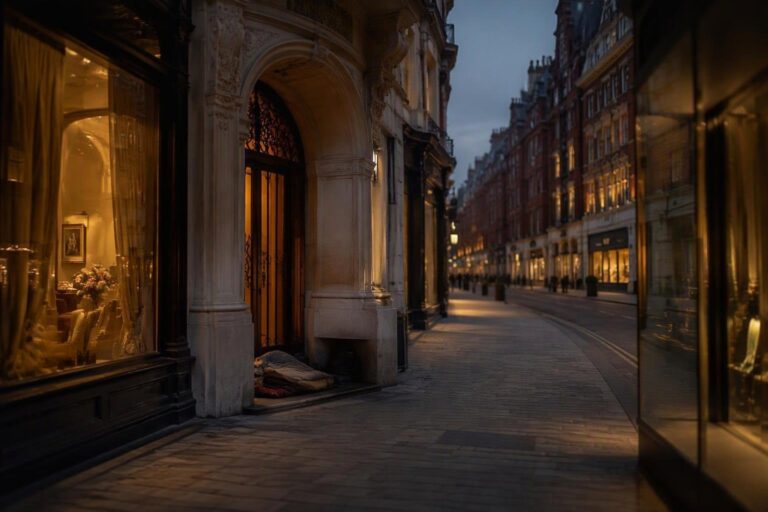
In the heart of London’s most expensive district, the Connaught Hotel offers suites that command £20,000 a night and a flagship restaurant boasting three Michelin stars. Yet the same stretch of Mount Street and Carlos Place has recently become the setting for an improvised camp of homeless migrants who are sleeping in doorways and using the pavement as a makeshift toilet.
Residents of the area first noticed a growing cluster of rough sleepers in the early evening. By nightfall, around fifteen individuals were observed huddled in the shadows of historic Georgian townhouses, next to Bentleys and a parked Porsche. Homemade cardboard signs displayed pleas such as “Homeless please help me.
God bless you. Thank you.” and the stark “I’m hungry”. The encampment spreads from the doorstep of the luxury leather-goods maker Tanner Krolle to the entrance of the Dr Barbara Sturm skincare boutique, whose apartments above cost roughly £3.7 million.
Day-to-night contrast on Mayfair’s elite avenues
When the sun rises, Mount Street transforms into a runway for the city’s wealthiest. Bentleys glide past immaculate Georgian façades, designer boutiques showcase handbags priced in the tens of thousands, and the nearby Scott’s seafood restaurant—famed for a 2013 incident involving Charles Saatchi and Nigella Lawson—welcomes diners seeking lavish experiences. By contrast, after dark the same pavement becomes a scene more reminiscent of a third-world settlement, with migrants erecting makeshift bedding, discarding litter, and relieving themselves in the street.
One local office worker, who has been tracking the situation for two weeks, remarked that the scene is “almost as bad as Oxford Street”. He added, “This is one of the most expensive and exclusive areas of Europe, yet people are sleeping in doorways just yards from the Connaught.” He estimates the group arrives around 7 pm and disappears near 7 am, leaving the sidewalks strewn with personal belongings.
Wider context of rough sleeping across London
London’s rough-sleeper figures have shown a modest decline recently: outreach teams recorded 3,959 people sleeping on the streets between April and June, a 10 percent drop compared with the same period last year. Of those, 1,685 were new to the streets, 680 were classified as chronic rough sleepers, and 1,645 were intermittent. However, analysts note that migrants with precarious immigration status often refuse assistance and are therefore omitted from official tallies.
Other makeshift encampments have been documented near the flagship Marks & Spencer on Oxford Street, on Euston Road, in Shoreditch’s trendy lanes, and in north London’s Clissold Park. Local businesses in those areas have complained about litter, rats, and public urination, while charities warn that rough sleeping remains “extremely high by historic standards”.
Political and municipal response
The issue has become a political flashpoint. Mayor Sadiq Khan pledged during his 2024 re-election campaign to eradicate rough sleeping in the capital, while Westminster Council, now under Conservative control, has previously blamed Labour for the persistence of street-level homelessness on Oxford Street. Disputes over land ownership and the legal ability to remove encampments have further complicated any swift action.
Attempts by nearby restaurant staff to relocate the migrants have reportedly been rebuffed; many of the individuals appear to decline temporary accommodation, opting instead to remain where they feel most secure. One worker explained, “If you ask them politely they say ‘no English, no English’. If you persist they become angry and start swearing.”
The stark juxtaposition of ultra-luxury establishments—such as the three-star Michelin restaurant, the £3.7 million apartments above Dr Barbara Sturm’s clinic, and the historic Connaught hotel—with a visible homeless camp underscores the widening gap between wealth and vulnerability in London’s core.