A generation of Lebanese students faces interrupted learning as schools are destroyed, repurposed as shelters, or left unreachable
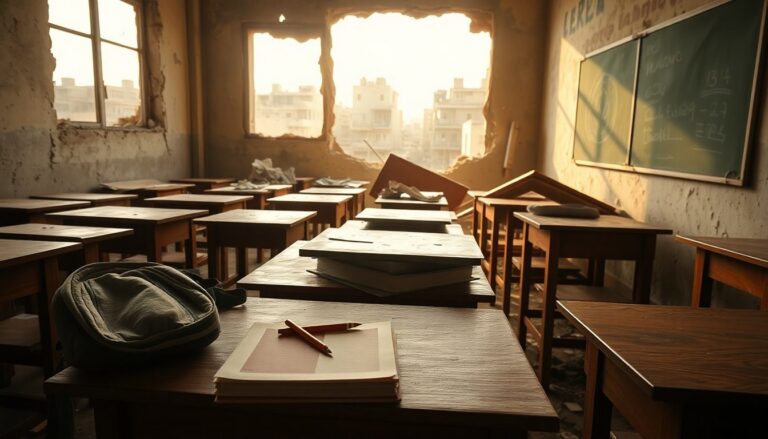
The conflict affecting Lebanon has fractured the routine of schooling and left many young people at risk of falling out of the education system. In large parts of the country, particularly the south, physical damage to buildings and mass displacement have combined to produce what observers call a lost generation — children and adolescents whose schooling has been repeatedly interrupted.
The situation is not only about closed classrooms: it touches on psychosocial trauma, household poverty and the erosion of basic educational infrastructure.
Official estimates and monitoring groups document a heavy human toll. Since March 2, hostilities escalated dramatically after months of cross-border incidents that followed earlier clashes, including more than 10,000 violations of the November 2026 ceasefire.
UNESCO reports that roughly 1.2 million people in Lebanon have been displaced and around 500,000 school-aged children are among them. The agency also notes that 339 schools sit in active conflict zones, hundreds of additional schools serve as collective shelters for displaced families — affecting another 250,000 children — and around 100 schools are classed as high risk and could become unusable soon.
Adaptations and their limits
Faced with closures and disrupted attendance, schools and authorities have adopted short-term measures to keep learning going. Remote teaching, staggered shifts at public institutions and temporary learning centres have been rolled out in many areas, often in coordination with the Ministry of Higher Education and UNESCO. These interventions aim to preserve continuity and to integrate psychosocial support into learning environments, helping children process fear, loss and repeated displacement. Yet these fixes are uneven in reach and quality, and many families cannot benefit.
Remote learning and hybrid systems
Hybrid learning — a blend of in-person and online instruction — has become a practical solution after years of successive crises, from the 2019 protests to the COVID-19 pandemic and the economic collapse. But access is highly unequal: unreliable electricity, intermittent internet, lack of devices and unstable housing make online lessons inaccessible for many. Researchers such as Tala Abdulghani point out that while some students manage to continue, large numbers are effectively excluded, with learning losses compounding year after year. The result is an education landscape where participation often depends on household resources and location rather than merit.
Temporary centres and psychosocial support
Where classrooms are unusable, authorities and non-governmental actors have set up temporary learning centres and increased school shifts to absorb displaced children. These sites frequently include counselling and mental health services to address trauma and anxiety caused by exposure to violence and chronic uncertainty. As UNESCO education specialist Maysoun Chehab explains, children are not only losing instruction time but also stability, social connections and routine — factors that are central to healthy development and educational success.
Inequality, teachers and long-term risk
Beyond the immediate disruption, the crisis is amplifying long-standing social and economic divides. Lebanon’s economic collapse had already eroded the middle class: the Lebanese Center for Policy Studies records a rise in the Gini coefficient from 0.32 in 2011 to 0.61 in 2026, and a 2026 ESCWA report placed Lebanon among the most unequal countries globally. Those structural inequalities now mean that children’s chances of continuing education are increasingly determined by geography and household income rather than policy or effort. With humanitarian funding constrained, families face harsh trade-offs that push some children into child labour or early marriage.
Teachers under strain
Teachers, the backbone of schooling, have endured overlapping shocks. Years of currency collapse slashed real incomes — salaries fell by an estimated 80% in value — prompting many educators to take on extra work or to emigrate. Since 2019, roughly 30% of the education workforce either left the profession or the country, creating shortages and eroding quality. Many teachers are themselves displaced or living under threat, which undermines their ability to provide stable instruction and to support children coping with trauma. Observers acknowledge the competence of the current education minister, Rima Karami, while stressing that structural reforms and extraordinary resources are required to avert long-term damage.
What is at stake and what comes next
Experts warn that without bold, coordinated action the country risks cementing a widening educational divide that will have durable effects on social cohesion and economic prospects. Policy proposals range from scaling up safe learning spaces and investing in teacher retention to ensuring predictable humanitarian financing and adopting flexible curricular approaches that reintroduce subjects like civic education alongside core academic recovery. If left unaddressed, the interruption of schooling could translate into a cohort of young people with diminished opportunities and weakened bonds across Lebanon’s diverse communities — an outcome many see as avoidable with timely, sustained intervention.