

Keir Starmer: Committed Leadership Amidst Challenges Keir Starmer stands firm and dedicated to his leadership role, demonstrating resilience against increasing calls for his resignation. His unwavering commitment to the values of his position reflects a strong ability to navigate complex political landscapes while prioritizing the needs of his constituents.
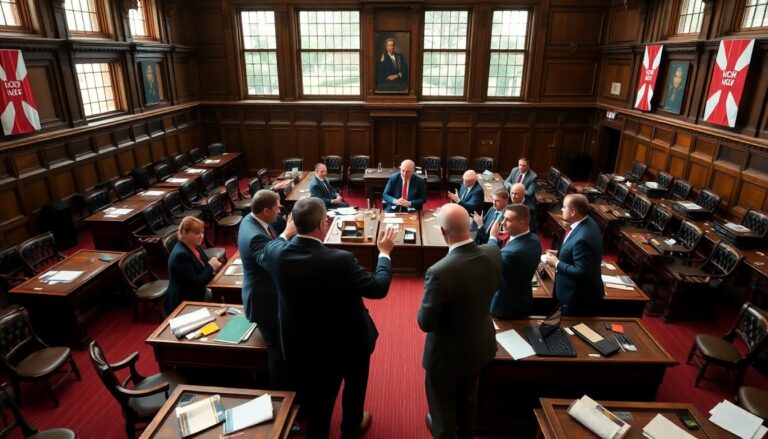
In a challenging political landscape, Keir Starmer, the leader of the Labour Party, has publicly asserted that he will not resign despite significant pressure from within his party. His determination follows a scandal involving former Labour peer Peter Mandelson and his connections to Jeffrey Epstein.
Starmer’s steadfastness was on display during a recent meeting with Labour MPs, where he emphasized his commitment to the party and the country.
Starmer’s assertion that he is ‘not prepared to walk away’ reflects his desire to maintain stability within Labour.
He stated, ‘After fighting hard for the chance to change our country, I will not abandon my mandate or my responsibilities.’ His remarks underline a broader message of resilience and determination in the face of adversity.
Internal strife within Labour
The pressures on Starmer intensified when Anas Sarwar, the Scottish Labour leader, publicly called for his resignation. This dramatic announcement came during a press conference where Sarwar expressed that leadership in Downing Street needed to change to end ongoing distractions. His comments signal a growing rift within the party as Labour approaches crucial elections.
The implications of Sarwar’s call
Sarwar’s criticism stems from Labour’s declining popularity in Scotland, where they are struggling against the Scottish National Party (SNP) and the right-leaning Reform UK party in the upcoming elections. With the SNP having held power since 2007, Labour’s earlier resurgence in Scottish politics under Sarwar’s leadership now appears threatened by the fallout from the Mandelson affair.
The Scottish Labour leader’s framing of the issue highlights his loyalty to Scotland and the need for strong leadership to prevent another decade of SNP governance. However, his public call for Starmer’s resignation also places him in a precarious position, risking alienation from the central party leadership.
Support for Starmer within the party
Despite the unrest, several key figures within Labour have rallied to Starmer’s defense. David Lammy, the Deputy Prime Minister, emphasized Starmer’s mandate earned during the last general election, asserting that the party should remain focused on its mission to transform Britain. Other cabinet members echoed this sentiment, reinforcing the notion that Starmer’s leadership remains crucial to the party’s future.
The role of cabinet support
Chancellor Rachel Reeves and Communities Secretary Steve Reed were among those who publicly expressed their backing for Starmer, stressing the importance of unity as they navigate the political storm. Reeves highlighted the positive changes being implemented under Starmer’s leadership, while Reed recalled the mandate Starmer secured when he led the party to victory.
However, tensions within the party have led to significant changes in Starmer’s team. The resignation of his chief of staff, Morgan McSweeney, has raised questions about the stability of Starmer’s leadership. McSweeney’s departure, along with that of director of communications Tim Allan, has prompted discussions about the need for a complete overhaul of Starmer’s inner circle.
Looking ahead: The fight for Labour’s future
As the Labour Party prepares for the upcoming local elections in May, Starmer’s leadership is under intense scrutiny. While Sarwar’s public dissent may have weakened Starmer’s position, it compels the party to confront its internal divisions and reassess its strategy moving forward. The next few months will be critical in determining whether Labour can unify and regain its footing in Scottish and national politics.
Starmer’s commitment to fighting against Reform UK is a vital part of his strategy, as he views the party as a significant threat to Labour’s values and the unity of the nation. He stated, ‘If they ever get in, they will divide this beautiful country apart,’ emphasizing the importance of standing firm against divisive politics.
Starmer’s assertion that he is ‘not prepared to walk away’ reflects his desire to maintain stability within Labour. He stated, ‘After fighting hard for the chance to change our country, I will not abandon my mandate or my responsibilities.’ His remarks underline a broader message of resilience and determination in the face of adversity.0
