

An all-island funding programme paid for solar panels and batteries at Donegall Pass Community Centre, saving the south Belfast site about £7,000 a year and creating a test model for other council buildings.
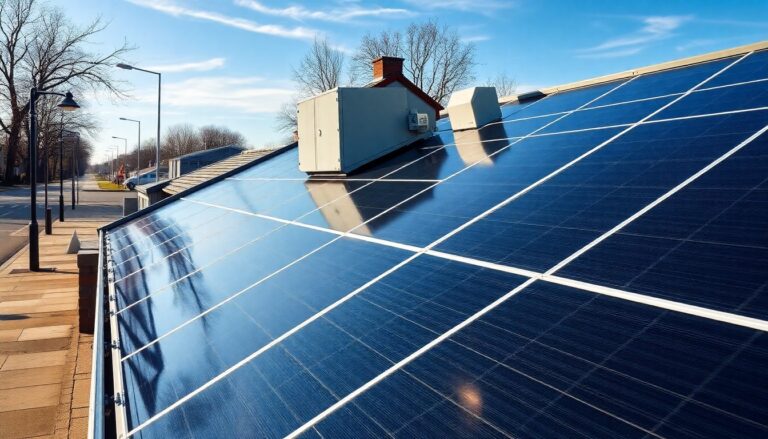
Renewable upgrades at Donegall Pass community centre cut bills and emissions
The south Belfast neighbourhood of Donegall Pass has become a visible example of cross-border cooperation delivering local benefits. An installation of solar photovoltaic (PV) panels and battery storage at the community centre on Apsley Street has reduced annual electricity costs by roughly £7,000 while also cutting the building’s carbon footprint.
Officials told Belfast City Council’s Climate and City Resilience Committee that funding from the Irish Government’s Shared Island initiative enabled the renewable upgrades. The centre will serve as a demonstration site to guide similar energy projects at other council-managed properties.
Funding and partnership details
Belfast City Council secured €46,620 from the Shared Island Fund to install solar PV on the Donegall Pass community centre. The council also received €4,500 to add battery storage. The grants followed a joint feasibility process with Cork City Council to identify high-yield sites with significant energy use.
The Shared Island initiative began with an initial package of €500 million and was expanded in to a commitment of €2 billion, running through to 2035. The fund aims to use the Good Friday Agreement framework to support projects with an explicit North–South dimension and a clear community focus, prioritising investments that deliver measurable local benefits.
Selection criteria and joint applications
Officers selected community buildings that combined strong potential for solar generation with relatively high energy use. This approach aimed to maximise the immediate effect of the investment on local energy costs. A feasibility study undertaken in partnership with Cork City Council reviewed council-owned sites in both cities and guided a joint application. That application resulted in installations at three community centres: Donegall Pass in Belfast and two sites in Cork — Fairhill Fairfield Community Association and St. Vincent’s Hurling and Football Club. The projects were chosen to support community-led activity while delivering measurable local benefits.
Energy, savings and carbon impact
The installed systems are intended to lower grid electricity consumption at the centres. Reduced consumption should translate into lower operating costs for community facilities. Officers will monitor system performance to track actual energy savings and inform future investments.
Local authorities said they will also assess the projects’ effect on carbon emissions as part of routine evaluation. Monitoring will use generation data and consumption records to estimate emissions reductions. Findings will guide maintenance plans and help determine whether similar schemes can be scaled to other community buildings.
Project partners plan to share performance data with stakeholders and the public. The aim is to ensure transparency and to help other councils and community groups replicate successful elements. Continued oversight will focus on system reliability, financial savings, and community benefit.
Continued oversight will focus on system reliability, financial savings and community benefit. Council reports estimate the new roof-mounted panels will generate roughly double the energy currently used by the Donegall Pass Community Centre. That surplus reduces reliance on grid electricity and translates directly into cost savings of about £7,000 per year.
From an environmental standpoint, the scheme is projected to cut emissions by approximately 13 tonnes CO2e/kWh annually, a figure the council used to convey the scale of benefits in relatable terms. Officers compared the avoided emissions to commonplace activities: the annual reduction is equivalent to charging a smartphone around 120,000 times. The report notes the analogy simplifies complex emissions accounting but aids public understanding.
Battery storage and test-site ambitions
Council documents state further plans include on-site battery storage to capture surplus generation and increase resilience. Trial installations will assess how batteries improve peak-time self-use and reduce export to the grid. Monitoring will measure performance, maintenance demands and the scheme’s contribution to local energy security.
Officers said results from the test sites will guide possible expansion to other community buildings. Ongoing evaluation will report on actual savings, operational performance and carbon outcomes to inform future investment decisions.
Ongoing evaluation will report on actual savings, operational performance and carbon outcomes to inform future investment decisions.
A subsequent funding award enabled the council to purchase batteries to store excess daytime generation for use when demand rises or solar output falls. The council will use Donegall Pass as a test site to monitor how an integrated solar plus battery system operates within a community centre. Observations will focus on system performance, user interaction and whether the model can be replicated across other council properties.
Community engagement and future rollout
Beyond hardware installation, the council’s climate team is coordinating with the Energy Manager, outreach staff and centre personnel to inform centre users about the project. The programme aims to increase understanding of how the panels lower emissions, reduce energy bills and release funds for services and activities.
Staff outreach will promote energy-conscious behaviours that maximise the new system’s benefits. Training and informational materials will explain charging and usage patterns that align with battery storage, and staff will record user feedback for technical and operational review.
Findings from Donegall Pass will feed into a council-wide assessment of cost-effectiveness and transferability. Results will be used to guide decisions on wider rollout and future capital allocations.
Learning from Donegall Pass to inform wider municipal energy plans
Officials will use findings from the Donegall Pass trial to shape broader council proposals for renewable installations at municipal sites. The evaluation will document technical performance, storage behaviour and user engagement outcomes to refine a replicable model for energy upgrades across other council-managed centres and buildings. This follows the council’s decision to apply trial insights when prioritising future capital allocations.
Micheal Donnelly, Sinn Féin councillor and committee chair, welcomed the cross-border collaboration. He said the partnership between Donegall Pass Community Centre, Fairhill Fairfield Community Association and St Vincent’s Hurling and Football Club linked Belfast with Cork around an energy-saving initiative. His remarks framed the project as delivering local benefits while strengthening North–South civic ties.
Next steps include consolidating technical reports and community feedback to guide decisions on wider rollout and subsequent funding recommendations.
Officials will use the consolidated technical reports and community feedback to recommend whether similar installations should proceed across other municipal sites. That process will assess cost-effectiveness, grid integration challenges and likely timelines for wider deployment.
As a targeted example, the Donegall Pass project illustrates how modest capital injections can deliver both environmental benefits and local economic uplift through lower energy bills and enhanced site resilience. If the pilot’s metrics remain favourable, council leaders may propose phased investments to reduce operational costs across properties and to strengthen municipal climate adaptation measures.
Decision-makers have signalled they will present funding recommendations to elected committees once evaluation is complete. Further monitoring data and stakeholder submissions will inform the next tranche of proposals under the Shared Island initiative.
