

As tensions rise in Gaza, Sir Keir Starmer's remarks spark a political firestorm in the UK.
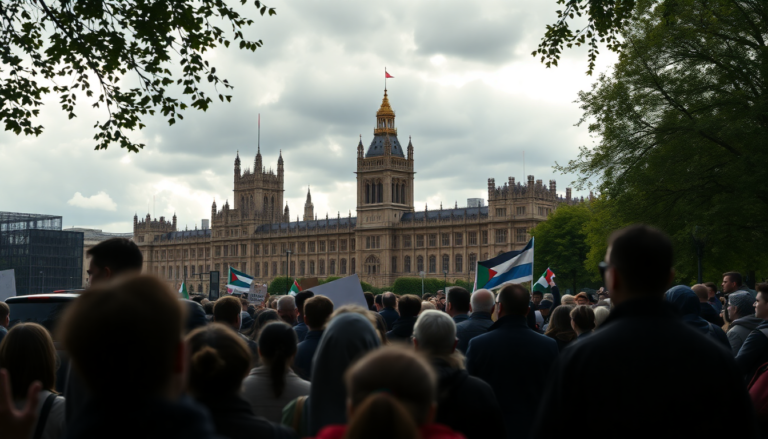
As the conflict in Gaza continues to unfold, Sir Keir Starmer, leader of the UK Labour Party, finds himself under increasing pressure to hold back his comments. This comes on the heels of a stern warning issued by UK Prime Minister regarding Israel’s military operations in Gaza City.
To complicate matters, officials in the U.S. have also criticized Starmer’s position, adding fuel to an already volatile situation.
Who, What, When, Where, Why?
On Friday, U.S. Vice President JD Vance raised eyebrows by pointing out the different strategies the UK and the U.S.
are taking to reach their common goals in the Middle East. This sentiment was echoed by Washington’s ambassador to Israel, Mike Huckabee, who controversially compared Starmer’s hypothetical leadership during World War II to the present political landscape in Britain.
Huckabee went so far as to claim that under Starmer, Britain would have lost the war, igniting a firestorm of reactions.
Starmer’s comments were triggered by Israeli Prime Minister Benjamin Netanyahu‘s announcement of new military principles aiming for the “demilitarization of the Gaza Strip” while maintaining security control for Israel. The Israeli Defence Forces (IDF) are preparing for potential control over Gaza City, but they have also vowed to provide humanitarian aid to civilians in areas less affected by the conflict.
“The Israeli government’s decision to further escalate its offensive in Gaza is wrong,” Starmer stated firmly. He urged for a reassessment of military actions and called for an increase in humanitarian aid. However, his remarks were met with sharp criticism from Huckabee, who questioned the reasoning behind such demands in light of the ongoing hostage crisis involving Israelis.
Political Reactions and Implications
This back-and-forth has highlighted a growing rift within UK politics over how best to respond to the Gaza crisis. Starmer’s push for a ceasefire and humanitarian measures has garnered skepticism from figures like Huckabee, who accused him of essentially advocating for Israel to surrender to Hamas. “So Israel is expected to surrender to Hamas and feed them even though Israeli hostages are being starved?” Huckabee exclaimed.
Looking at the bigger picture, Starmer has made it clear that he plans to recognize a Palestinian state unless the Israeli government takes significant steps to tackle the humanitarian crisis in Gaza and agrees to a ceasefire. His conditions also include guarantees against annexations in the West Bank, a longstanding contentious issue in the peace process.
On the international front, Foreign Secretary David Lammy and other allied foreign ministers have voiced strong opposition to Israel’s military plans, warning that these actions could exacerbate the humanitarian situation and violate international law. A joint statement from several nations has stressed the necessity for a negotiated two-state solution as the only viable way forward.
The Future of UK-Israel Relations
The ongoing discussions surrounding Gaza and their implications for UK-Israel relations are anything but simple. While the UK government has approached the issue cautiously, trying to balance domestic political pressures with international diplomacy, the Labour Party’s position under Starmer may evolve if public sentiment increasingly leans towards a more humanitarian-focused policy.
As the humanitarian situation in Gaza grows more dire by the day, the international community is watching closely. The UK stands at a critical crossroads in its foreign policy, particularly regarding its longstanding relationship with Israel. Starmer’s leadership and the decisions he makes in this tumultuous moment could shape not only the future of his party but also the UK’s role in the Middle Eastern peace process.
