

Riek Machar's Trial: Implications for South Sudan's Political Landscape The trial of Riek Machar, a prominent figure in South Sudan's political arena, is generating significant discourse regarding the future stability and governance of the nation. As political tensions continue to rise, this legal proceeding not only impacts Machar's personal fate but also poses critical questions about the broader implications for South Sudan's peace process and political dynamics. Stakeholders are closely...
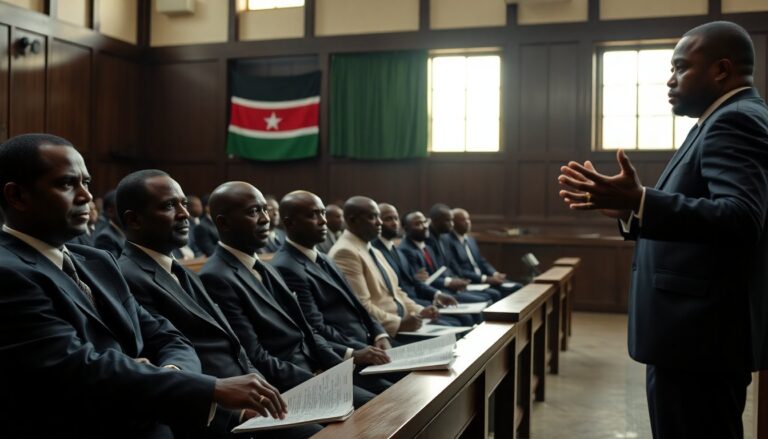
In mid-October, Riek Machar, the first vice president of South Sudan and a significant opposition leader, faced serious charges in a courtroom that had previously served as an events hall. His demeanor during this crucial moment was surprisingly upbeat, contrasting sharply with the gravity of the situation.
Machar, along with 20 members of the Sudan People’s Liberation Movement/Army-in-Opposition (SPLM/A-IO), was indicted on severe allegations, including terrorism, treason, and crimes against humanity. These charges stem from a March attack on a military installation, which the government claims resulted in over 250 fatalities among soldiers.
Machar has vehemently denied these allegations, with the SPLM-IO branding them as politically driven and without merit. The proceedings, which began in late September and are open to the public, have drawn significant attention. Over a thousand individuals attended the trial, reflecting the deep public interest and the political stakes involved.
The evidence
Documents in our possession show that observers have voiced concerns over what they perceive as the government’s manipulation of the judiciary to eliminate President Salva Kiir’s main political adversary. This perspective has fueled resentment among Machar’s supporters, potentially igniting further violence in a nation already grappling with instability. Lincoln Simon, a nonprofit director attending the trial, expressed apprehension, stating, “This is a political trial. The state is using the court against its opponents.” He believes that the government is seeking to distract from its failures, such as rampant inflation and lack of services.
Public perception and support
William Tong, a retired factory worker and a longtime supporter of Machar, echoed similar sentiments. He emphasized the necessity for transparency in the judicial process, noting that the public is eager for substantial evidence. “We are watching this trial to see whether or not this is a country run by the rule of law,” he commented. Tong, however, remains unconvinced by the evidence presented so far.
Conversely, there are individuals like James Majok, who support the trial as a necessary step towards accountability for public officials. Majok believes that it is crucial for anyone accused of wrongdoing to be tried in a fair manner, maintaining that “the law should apply to everybody.” His perspective highlights a division in public opinion regarding the legitimacy of the trial and what it represents for the future of governance in South Sudan.
The reconstruction
The trial of Riek Machar is deeply intertwined with the turbulent history between him and President Kiir. Their animosity has roots in a civil war that erupted from 2013 to 2018, resulting in an estimated 400,000 casualties. While a peace agreement eventually brought them into a unity government, the subsequent years have seen little implementation of its provisions amid ongoing economic and humanitarian crises.
Many believe that this trial possesses ethnic dimensions, as Kiir’s inner circle predominantly belongs to the Dinka ethnic group, the largest in South Sudan. Conversely, all 21 defendants, including Machar, are Nuer, the country’s second-largest ethnic group. This context raises alarms among citizens like Simon, who fear that the trial could exacerbate ethnic tensions and further divide the nation.
Broader implications for peace
The ongoing violence involving various armed factions has raised significant concerns regarding the stability of the 2018 peace deal, which is viewed as a fragile foundation for South Sudan’s governance. Daniel Akech, an expert on South Sudan, highlighted that the stakes are incredibly high: “If the process is not managed with extreme political care, the fallout could shatter the country’s fragile cohesion.”
Machar, a controversial figure with a lengthy history in South Sudan’s politics, has been both a rebel leader and a vice president. His past actions, including a break from the SPLM in the 1990s and leading a new faction, have made him a polarizing character. Despite his recent decline in popularity, many still see him as the embodiment of resistance against the ruling government.
Constitutional and legal challenges
While Machar is not subject to the death penalty due to constitutional provisions for individuals over 70, he faces life imprisonment and potential disqualification from political office. His co-defendants, however, could face harsher penalties. Legal experts have pointed out that the trial’s legitimacy is questionable under the terms of the peace agreement, which calls for neutral oversight in cases involving political figures.
Machar has vehemently denied these allegations, with the SPLM-IO branding them as politically driven and without merit. The proceedings, which began in late September and are open to the public, have drawn significant attention. Over a thousand individuals attended the trial, reflecting the deep public interest and the political stakes involved.0
What happens next
Machar has vehemently denied these allegations, with the SPLM-IO branding them as politically driven and without merit. The proceedings, which began in late September and are open to the public, have drawn significant attention. Over a thousand individuals attended the trial, reflecting the deep public interest and the political stakes involved.1
Machar has vehemently denied these allegations, with the SPLM-IO branding them as politically driven and without merit. The proceedings, which began in late September and are open to the public, have drawn significant attention. Over a thousand individuals attended the trial, reflecting the deep public interest and the political stakes involved.2
