

Discovering Early Christian Art: The Unveiling of a Remarkable Fresco of Jesus as the Good Shepherd in Turkey A breathtaking fresco depicting Jesus as the Good Shepherd has recently been uncovered in Turkey, providing valuable insights into early Christian artistry and its cultural significance. This remarkable discovery highlights the intricate craftsmanship and theological themes present in early Christian art, offering a glimpse into the spiritual beliefs of that era.
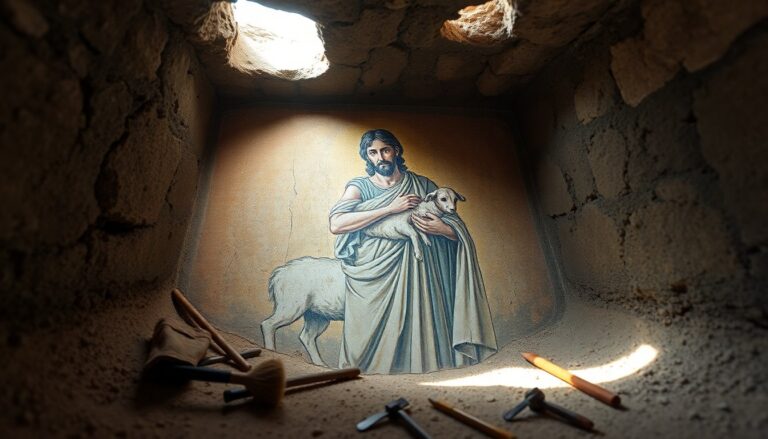
Archaeologists have made a remarkable discovery in the depths of Anatolia, uncovering a stunning fresco of Jesus depicted as the Good Shepherd. This significant find occurred in August at an underground burial site in Iznik, a town noted for its crucial role in Christian history, particularly as the location where the Nicene Creed was adopted in 325 AD.
The fresco features a Roman-inspired portrayal of a youthful and clean-shaven Jesus, dressed in a toga while carrying a goat over his shoulder. This artwork is particularly significant as it represents one of the few instances in Anatolia where Jesus is depicted with distinctly Roman features, a region known for its scarcity of early Christian representations.
The historical significance of the discovery
This significant discovery originates from a tomb believed to date back to the third century, during a period when Christians in the Roman Empire faced considerable persecution. The area, now part of modern-day Turkey, has played a crucial role in the early history of Christianity, with notable figures such as St.
Paul and St. John having connections to this region.
Lead archaeologist Gulsen Kutbay stated that this fresco might be the only example of its kind discovered in Anatolia. The artwork is exceptionally well-preserved, allowing for an in-depth examination of its intricate design, which features a variety of motifs depicting birds and plants that embellish the tomb’s walls and ceiling.
The cultural context
The Good Shepherd motif has been a significant symbol in early Christianity, embodying protection, salvation, and divine guidance long before the cross became the universal emblem of the faith. This fresco serves as a crucial link to understanding how early Christians expressed their beliefs during periods of adversity.
In addition to the fresco, the excavation revealed the skeletal remains of five individuals. Anthropologist Ruken Zeynep Kose highlighted that poor preservation conditions hindered the determination of the ages of two individuals. However, the findings included two young adults and a six-month-old infant, suggesting a diverse burial site.
Papal visit and the celebration of Christian unity
Pope Leo XIV visited Iznik as part of his inaugural overseas journey, marking the 1,700th anniversary of the Council of Nicaea. Accompanied by patriarchs and priests from both Eastern and Western churches, they collectively prayed for unity among Christians worldwide. This gathering highlights Iznik’s enduring significance in the Mediterranean religious landscape.
During the visit, Turkish President Recep Tayyip Erdoğan presented Pope Leo XIV with a tile painting depicting the Good Shepherd fresco. This gesture emphasizes the cultural and historical importance of the discovery, resonating deeply within the Christian community.
The future of archaeological exploration in Iznik
New findings shed light on early Christian art in Iznik
A recent discovery has enhanced our understanding of early Christian art and suggests further archaeological exploration in the area. The tomb housing the fresco may still conceal additional surprises, potentially including more iconographic cycles hidden beneath layers of earth and plaster.
As archaeologists advance their work in the Hisartepe necropolis, they have the opportunity to investigate centuries of burial practices and artistic expressions that illustrate the diverse social fabric of ancient Iznik. The discovery of the Good Shepherd fresco signifies a significant moment in comprehending the spread of Christianity and its early representations in a region where such imagery has been largely absent.
The discovery of this fresco contributes significantly to understanding early Christian history in Anatolia. It highlights the complex relationships between faith, art, and cultural identity amid historical challenges.
