Experience the celestial wonder as the solar eclipse graces the UK skies, offering a breathtaking view for millions. Find out the best spots and safety tips to enjoy this rare event.
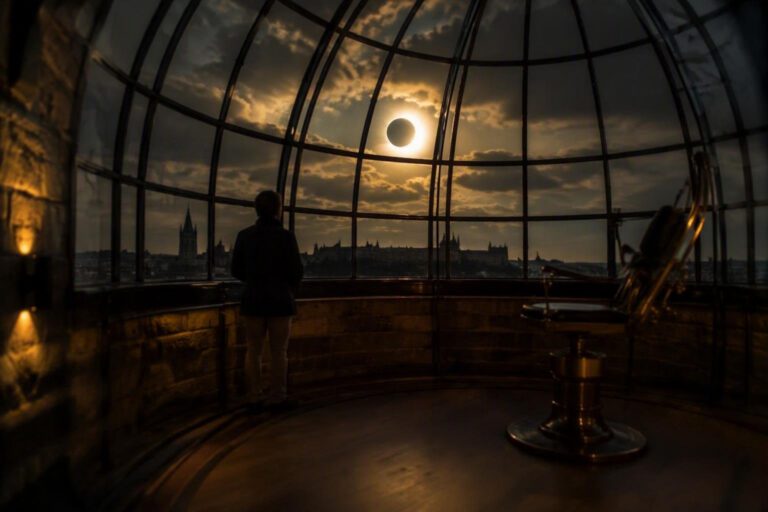
The UK was treated to a celestial spectacle on Wednesday evening as a solar eclipse reached its peak, covering over 90% of the Sun. This remarkable event, the most significant since August 1999, drew crowds to various viewing spots, including Calton Hill in Edinburgh and the Royal Observatory Greenwich in London.
Enthusiasts gathered with special glasses, homemade viewers, and cameras to capture the moment. The eclipse, which began around 18:01 BST and peaked just after 19:05, offered a unique opportunity for both amateur and seasoned astronomers to witness the Moon’s journey across the Sun.
The Best Places to View the Eclipse in Scotland
Astronomers recommended elevated locations with unobstructed views to the west for the best experience. Prof Catherine Heymans, the Astronomer Royal for Scotland, noted that Scotland’s later sunset times provided a clearer view compared to England.
The eclipse started between 18:01 and 18:10 BST and ended just before 20:00, with the peak occurring around 19:05.
BBC Weather presenter Joy Dunlop highlighted that southern Scotland would have the most optimal conditions, with dry and clear skies. However, cloudy weather in the north west Highlands and the Western and Northern Isles posed challenges for visibility. High-level cloud could also make views hazy across the country.
Community Events Across Scotland
Numerous community events were organized to celebrate the eclipse. Beirhope Farm in the Scottish Borders hosted a talk from an astronomy expert, while the Dirleton Solar Walk in East Lothian offered certified eclipse glasses. The Edinburgh Playfair Observatory on Calton Hill provided insights from the Astronomical Society of Edinburgh.
Other notable events included the Whitelee Windfarm Visitor Centre in East Renfrewshire, which offered space-themed activities, and the Dark Space Planetarium in Kirkcudbright, which planned to use a solar telescope if skies were clear. These gatherings provided a communal experience for eclipse enthusiasts.
Safety Tips for Viewing the Eclipse
It is crucial to never look directly at the Sun during an eclipse. Eclipse glasses with safety certification ISO 12312-2 or ISO 12312-2:are essential for protecting your eyes from harmful rays. Regular sunglasses do not provide adequate protection, and even brief glances can cause significant eye damage.
Alternative methods for safe viewing include using a solar telescope or creating a pinhole projector. A colander can also be used to project an indirect image of the Sun onto a surface. Additionally, photographers should protect their cameras with eclipse glasses to avoid damage.
Prof Heymans emphasized the importance of following safety guidelines, noting that the eclipse lasts for about two hours, providing ample time to observe the event without risking eye damage. The Royal College of Ophthalmologists reported vision problems after the 1999 eclipse, highlighting the need for caution.
The Eclipse Experience in Scotland
While parts of Spain and Portugal experienced a total eclipse, Scotland was treated to a partial eclipse with up to 95% of the Sun obscured. This event, the most dramatic since 1999, offered a unique opportunity for stargazers to witness the celestial phenomenon.
Prof Heymans described the eclipse as a slow-moving event, with the Moon gradually covering the Sun over two hours. Although the Sun will not be entirely covered, the experience will be eerie and memorable. The next total eclipse is not expected until 23 September 2090, making this event particularly special.
For those unable to witness the eclipse in person, various hotels and rooftop bars across Europe, including Spain, the Balearic Islands, Iceland, Portugal, and Italy, offered special viewing experiences. These locations provided unique settings to enjoy the celestial spectacle safely and comfortably.