On Wednesday evening, the UK witnessed a solar eclipse that obscured over 90% of the sun, a spectacle not seen since 1999.
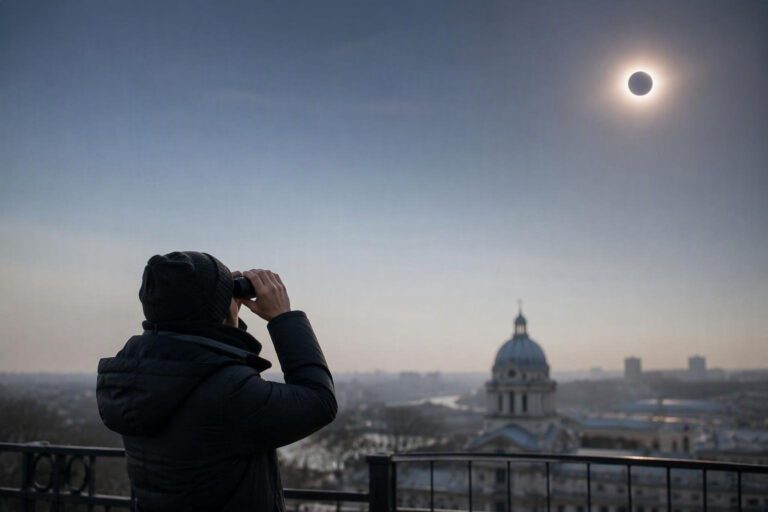
The UK was treated to a celestial spectacle on Wednesday evening as a solar eclipse obscured more than 90 per cent of the sun. This remarkable event, the most significant since the total eclipse of 1999, captivated onlookers across the country.
From the Royal Observatory Greenwich in London to Calton Hill in Edinburgh, and outside Queen’s University in Belfast, communities gathered to witness this rare phenomenon. Spectators brought a variety of viewing equipment, including homemade devices crafted from cereal boxes and colanders, as well as specialized solar eclipse glasses.
Emotional Responses and Community Spirit
Dhara Patel a space expert at the National Space Centre in Leicester, noted that witnessing a solar eclipse can be an emotional experience. Speaking to the Press Association she shared, “For a lot of people, it can be a little bit of an emotional event.
I’ve seen previously people being drawn to tears or just have a really good moment within themselves where they realise they’re seeing or witnessing something… you’ve never seen before in your life.”
Patel emphasized the uniqueness of this eclipse, stating, “We’ve had solar eclipses over the last couple of years, about 30% coverage. They’ve been good, but this is definitely a different scale. And what’s really nice is it’s a way for lots of people to come together and connect with nature – looking up at the sky at objects that we typically tend to take for granted.”
Preparations and Viewing Tips
In anticipation of the eclipse, convenience stores, national parks, and the Royal Greenwich Observatory exhausted their supplies of protective glasses. The observatory reported selling approximately 15,000 pairs of eclipse glasses in the last month, a testament to the public’s enthusiasm.
The Met Office provided detailed forecasts, indicating that Devon, Cornwall and the westernmost parts of Pembrokeshire in Wales would experience the eclipse at its fullest, with a range of 94% to 96% of the sun obscured by the moon. Plymouth in particular, was forecast to see the moon cover 94.66% of the sun at 7.16pm on Wednesday.
For those without specialized glasses, experts recommended using household items like colanders to safely view the eclipse. Imo Bell a planetarium astronomer at the Royal Greenwich Observatory explained, “You can project the image of the eclipse using a household item like a colander which has lots of holes in, point the colander towards the sun with your back facing it, and in the shadow of the colander you’ll be able to see the eclipse in the holes, which is really cool.”
Safety and Additional Celestial Events
Experts stressed the importance of using ISO 12312-2 certified solar eclipse glasses for safe viewing. Sunglasses are not sufficient, and looking directly at the eclipse without proper protection can cause vision problems. Following the 1999 total solar eclipse, the Royal College of Ophthalmologists reported around 70 cases of people experiencing vision issues after watching the eclipse, with around 40% having looked at it for less than a minute.
In an added bonus for stargazers, the annual Perseid meteor shower reached its peak on the night of August 12-13, hours after the eclipse. This shower is produced as Earth ploughs through a stream of dust left behind by Comet Swift–Tuttle creating a spectacular display of shooting stars.
The National Energy System Operator (Neso) had initially issued a call to the industry to generate more power during the eclipse but later cancelled it, stating that there was no risk to customer electricity supplies. Meanwhile, drivers were advised to turn on their headlights during the eclipse to ensure visibility on the roads.