Discover the latest developments in the Garvaghy Road parade dispute as tensions rise in Portadown, Northern Ireland.
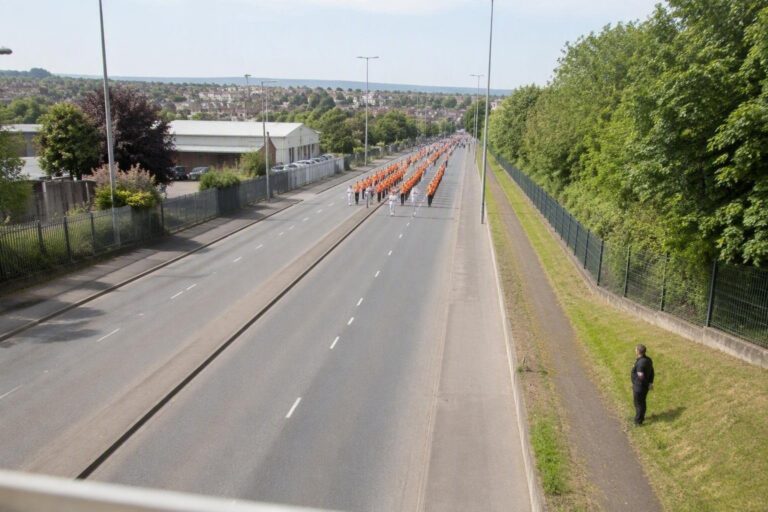
The long-standing dispute over parading on the nationalist Garvaghy Road in Portadown has reignited, following a High Court decision that quashed a Parades Commission ban on the Orange Order’s annual march. This contentious issue, which has been a flashpoint since 1998, has once again brought unionist and nationalist communities into conflict.
The High Court found that the Parades Commission had made a procedural error in its decision-making process, leading to the quashing of its ban. This legal victory has emboldened some unionist leaders to push for the restoration of the march, while nationalist representatives remain firmly opposed to any parade on the Garvaghy Road.
The Legal Battle and Its Implications
The legal challenge was brought by a member of the Orange Order, who argued that the commission’s decision breached his rights to freedom of belief, expression, and peaceful assembly under the European Convention on Human Rights.
The High Court agreed, stating that the commission’s decision ‘does not stand up to any scrutiny.’
The Parades Commission has acknowledged the procedural error and has already implemented changes to address the issue. However, the ruling has sparked a wave of reactions from political leaders and community representatives. The Grand Orange Lodge of Ireland welcomed the decision, calling it a ‘seismic victory’ and urging the secretary of state to examine the commission’s internal decision-making processes.
Political Reactions and Community Concerns
Sinn Féin councillor Catherine Nelson has categorically ruled out any talks on the parade, stating, ‘Nobody wants to see a parade down the Garvaghy Road.’ She suggested that the Orange Order could meet to discuss ending their ‘divisive ways.’ Meanwhile, Sinn Féin’s Infrastructure Minister Liz Kimmins criticized the disruption caused by the Royal Black Institution’s ‘Last Saturday’ parade in Newry, describing it as ‘totally unacceptable.’
The DUP’s Deputy First Minister Emma Little-Pengelly accused Sinn Féin of sectarianism and bigotry, arguing that the opposition to the parade was a denial of human rights. She called for an end to the ‘hypocrisy’ and urged all parties to ‘get on the same page.’ The Ulster Unionist leader Jon Burrows also criticized Kimmins’ language, describing it as ‘provocative.’
The Path Forward
The Orange Order has indicated its willingness to engage in mediation without preconditions, but nationalist residents’ groups have expressed skepticism. A representative of a residents’ group stated that discussions would be pointless if the Orange Order had a ‘pre-determined outcome.’ The Orange Order plans to consult with its legal team before submitting a fresh application to the Parades Commission.
First Minister Michelle O’Neill has expressed concern over the ‘triumphalism’ displayed by unionist leaders following the court ruling. She emphasized that the community does not want to revisit the ‘darkest days’ of the past. The Northern Ireland Secretary of State Chris Bryant has met with the Parades Commission chair to address the issues highlighted in the judgement and to restore public confidence in the commission’s decision-making processes.
As the dispute continues to unfold, the focus remains on finding a mutually agreeable and durable resolution that respects the rights and concerns of all communities involved.