French schools protest spirals into nationwide chaos, trapping a Scottish family in Orléans.
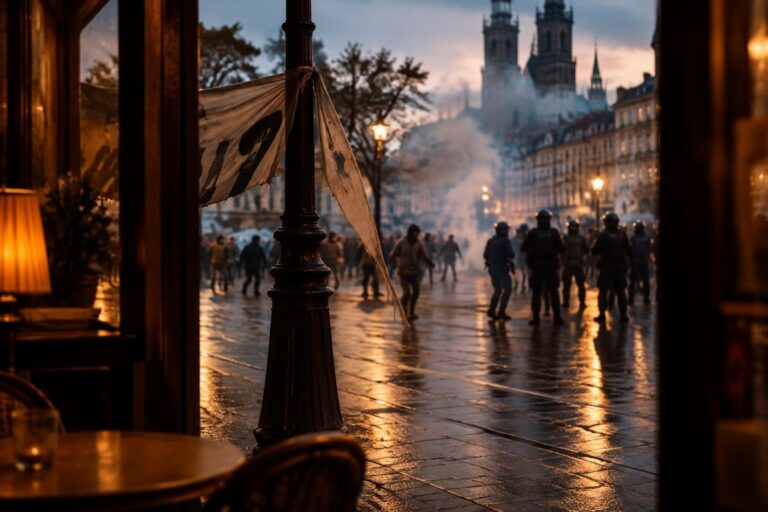
Over the past weekend, France has been engulfed by a wave of student protests that quickly grew beyond schoolyards. What began as demonstrations over school conditions in cities such as Lens and Orléans expanded into a broader outcry against soaring living costs, prompting clashes in major urban centres from Paris to Marseille.
Police reported dozens of incidents involving arson, looting and the destruction of storefronts, while authorities deployed water cannons and large quantities of tear gas to disperse dense crowds. By Sunday, the interior ministry confirmed more than 270 arrests, noting a “growing number of violent incidents” that included assaults on officers and damage to public property.
Nationwide unrest: from Paris to Marseille
In the capital, iconic avenues saw cars torched and high-streets ransacked as demonstrators shouted slogans against the government’s economic policies. Similar scenes unfolded along the Mediterranean coast, where youths in balaclavas gathered near train stations, prompting rapid police intervention.
The use of tear-gas grenades and riot shields became a common sight, with law-enforcement units advancing block by block to force protesters back into less populated districts. Local business owners described the chaos as “unprecedented”, citing extensive damage to shop fronts and a sudden drop in foot traffic that threatened the seasonal revenue of many small enterprises.
On the ground in Orléans: a Scottish family’s ordeal
Among those caught in the upheaval were Xanthe O’Brien and her 20-year-old daughter Flora, who had travelled from Edinburgh for a short stay while Flora worked as an English language assistant at a primary school in Orléans, a city situated roughly 75 miles southwest of Paris. The pair initially observed an orderly march organized by local students, but the atmosphere shifted dramatically after they returned to their hotel. According to Xanthe, “the reception doors were locked and the staff warned us not to go outside – it was not safe.” From their balcony they could see groups of teenage boys, many wearing balaclavas, chanting and launching fireworks, while police advanced with tear-gas canisters that filled the streets with a choking cloud.
Flora managed to record footage of the escalating scene, capturing officers pushing through crowds and the lingering haze of chemical irritants. The family was instructed to remain inside their room until the situation calmed, a directive echoed by hotel staff who feared the toxic fumes could seep through open windows. Xanthe described the night as “unsettling”, noting that the protesters continued to hurl fireworks even after the police had cleared the historic centre and taken positions at the train station. Their experience underscores how swiftly a local demonstration can turn into a full-scale security operation, leaving visitors isolated and uncertain about their safety.
Why French youth take to the streets more readily than their British peers
Experts point to France’s long-standing civic education as a key factor behind the current surge of mobilisation. From the age of eleven, French pupils engage in structured debates during “collège”, learning that protest is a constitutionally protected right and an essential element of citizenship. The national curriculum revisits the French Revolution, the 1968 student uprisings and the concept of the social contract penned by Rousseau, reinforcing the idea that citizens must actively defend the “volonté générale”. When policies such as pension reforms or steep utility price hikes appear to breach this implicit bargain, the instinct to demonstrate becomes a collective reflex.
In contrast, the United Kingdom’s recent history has cultivated a more individualistic approach to dissent. While Britain boasts a rich legacy of protests—from Peterloo to the suffragettes—the Thatcher era eroded trade-union power and fostered a cultural preference for personal grievance over mass mobilisation. Contemporary British youths often channel their activism through established organisations like Extinction Rebellion or participate in issue-specific rallies, rather than initiating spontaneous school-based blockades. This divergence explains why a Scottish mother and daughter, despite witnessing the French upheaval, found themselves advised to stay indoors rather than join the demonstrations.