

England’s reservoirs have fallen to historic lows, sparking emergency actions and a battle over business water restrictions.
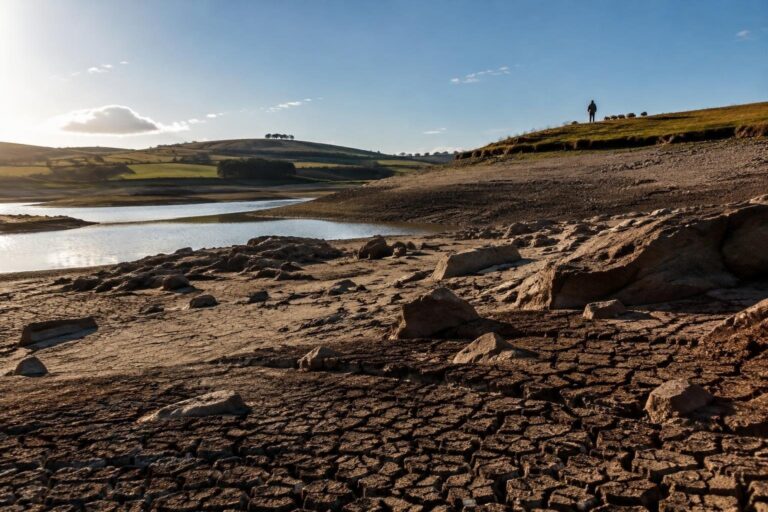
After experiencing the hottest summer on record, England has entered a period of severe drought across six counties: Devon, Cornwall, Dorset, Somerset, East Sussex and West Sussex. The situation has forced the government to declare a state of emergency for water supplies, prompting urgent coordination between the Environment Agency, water utilities and local authorities.
Residents are being urged to cut consumption, while the debate over extending non-essential water use bans to commercial premises intensifies.
Critical reservoir levels threaten public supply
Two of the country’s major storage sites are now hovering at alarmingly low percentages.
Ardingly reservoir which provides water to roughly 95,000 homes in Haywards Heath, Uckfield and surrounding settlements, is only 19% full. Even more dire is Wimbleball reservoir supplying South West Water customers across East and North Devon, Somerset and West Dorset, as well as Wessex Water customers in West Somerset; it stands at a mere 16% of its capacity.
By contrast, the Environment Agency normally expects reservoirs to hold about 75% of their volume at this stage of the year.
Smaller but still significant storages are also under strain. The Drift and Stithians reservoirs in Cornwall serve 56,000 households, while the Tottiford and Venford group in Devon provides for 47,000 homes. All are being closely monitored as water managers scramble to balance supply with demand.
Government directives and water firms’ emergency plans
Environment Secretary Angela Eagle announced that the current drought level is unprecedented in recent decades and that the government is stepping up support. She highlighted the need for water companies to protect public supplies, but stopped short of approving the requested extensions of water usage bans for businesses such as golf clubs, private schools and commercial car washes. Water minister Emma Hardy instructed the Environment Agency to give priority to public water supplies where environmental constraints clash with the urgent need for water.
South East Water, South West Water and Southern Water have each lodged formal requests to impose non-essential user bans. While the Secretary of State has not yet granted these measures, the companies have taken a range of operational actions. South East Water reports that 92 repair crews are active across Sussex and Kent, having reduced leak incidents from 181 to 97 and repaired over 1,300 leaks since 1 April. Pressure optimisation across the county has also been implemented to reduce wastage.
Wessex Water, which draws from the Wimbleball catchment, introduced its first hosepipe ban in five decades during August, and announced that the restriction will remain for the foreseeable future. The utility has increased leak repairs, redirected water from more resilient sources and fine-tuned local pressure settings to stretch the dwindling supply.
Broader impacts on agriculture and future outlook
The National Farmers’ Union (NFU) has warned that the year has been “torrid” for growers, with the dry spell hampering crop harvests, limiting water for livestock and raising the spectre of an equally dry winter that could jeopardise the next planting season. Philip Duffy chief executive of the Environment Agency, emphasised that although the weather cannot be altered, water companies must act now, adhere to their drought plans and ensure compliance checks on water abstractors to safeguard river flows and ecosystem health.
In addition to daily monitoring of reservoir and river levels, the National Drought Group has ordered heightened water-quality surveillance to address the reduced dilution of sewage, a factor that raises the risk of pollution to both human users and wildlife. The combined pressure of higher demand—recorded at more than 400 million litres per day for 48 consecutive days—and lower supplies underscores the severity of the crisis and the need for sustained public cooperation.
