Lewis Hamilton and other F1 drivers faced a chaotic LEGO minicar race and power deployment challenges at the 2026 British Grand Prix.
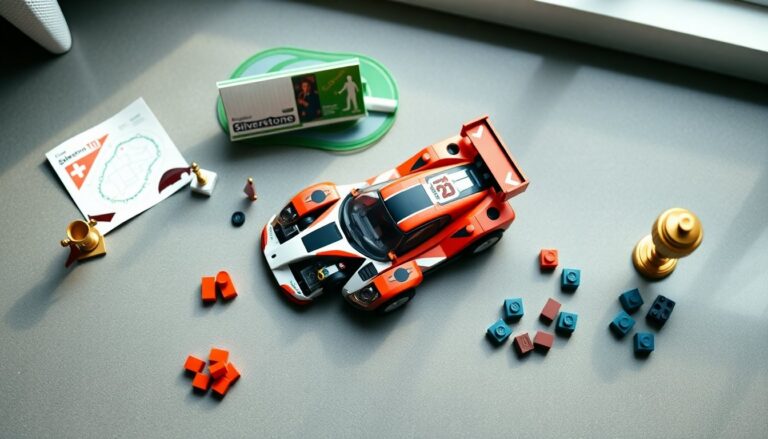
The 2026 British Grand Prix at Silverstone brought a mix of excitement and challenges for the Formula 1 grid. Lewis Hamilton, despite initial reservations, participated in the LEGO minicar race, which saw drivers navigating the track in custom-built vehicles made of 28,000 LEGO bricks.
The event, though playful, highlighted the unpredictable nature of the weekend.
Beyond the pre-race festivities, the drivers faced significant technical challenges due to the new car specifications. The lack of braking points and energy starvation meant that the cars were running with less than half the engine’s full power at key sections of the track.
This affected the high-speed corners of Copse and Becketts, where the cars had to rely more on internal combustion engines than electrical power.
The LEGO Minicar Race: A Playful yet Chaotic Event
The LEGO minicar race, a promotional event ahead of the British Grand Prix, saw all 22 drivers taking part.
FIA president Mohammed Ben Sulayem also joined in, driving his own minicar. The event was not without its mishaps, as several drivers, including Ben Sulayem, got stuck in the Silverstone gravel and had to lift their vehicles to continue. Carlos Sainz and Lando Norris shared a car, adding to the camaraderie and chaos of the event.
Fernando Alonso emerged as the winner of the LEGO race, driving for Aston Martin. This victory was a notable moment for Alonso, especially considering his team’s struggles during the season. The individual LEGO cars, each made of 28,000 bricks, were a step up from last year’s event in Miami, where team-mates shared a single car. The playful event provided a stark contrast to the technical challenges the drivers faced on the track.
Power Deployment Challenges at Silverstone
Lewis Hamilton described Silverstone as “a completely different circuit” due to the new car specifications. The lack of braking points and energy starvation meant that the cars were running with less than half the engine’s full power at key sections of the track. This affected the high-speed corners of Copse and Becketts, where the cars had to rely more on internal combustion engines than electrical power.
Hamilton noted that the cars would be recovering energy through Copse and Becketts, but the batteries would run out before the end of some high-speed sections. This resulted in the cars running with only the power from their internal combustion engines. The engines this year have a near 50-50 split between internal combustion and electrical power, with 350kW (470bhp) from electricity and a little over 400kW from the engine.
The power deployment issues were a significant topic of discussion among the drivers. Fernando Alonso expressed his concerns, stating that the situation was “quite sad, for the drivers, but also for the spectators.” He highlighted that the lack of deployment meant the cars had significantly less power than last year and even less than F2 cars. George Russell, however, saw a potential benefit, suggesting that the racing action could be quite interesting on energy-starved tracks.
The decision by the FIA not to allow straight-line mode on certain parts of the track added to the challenges. This decision, made for safety reasons, was opposed by five of the 11 teams. Russell noted that the Mercedes teams, who would have had a deployment advantage, were in favor of reinstating the straight-line mode. The issue is set to be addressed over the next two seasons with changes to the ratio of internal-combustion to electrical power.
The British Grand Prix: A Battle of Strategy and Speed
The British Grand Prix is known for its high-speed corners and challenging sequences, making it one of the most demanding tracks for drivers. The 2026 edition was no exception, with the new car specifications adding a layer of complexity. The drivers had to adapt their strategies to cope with the power deployment issues, which affected their performance on the track.
Lewis Hamilton, who has a record-breaking nine wins at Silverstone, was determined to add another victory to his tally. However, the technical challenges and the strong performance of other drivers, such as Kimi Antonelli and Charles Leclerc, made the race a fierce competition. The battle between the teams extended beyond the track, with tensions rising over cost cap budgets and strategic decisions.
The British Grand Prix is always a spectacle, and the 2026 edition was no different. With the LEGO minicar race adding a touch of whimsy and the technical challenges providing a test of skill and strategy, the event was a memorable one for both drivers and spectators. As the season progresses, the teams will continue to adapt and innovate, making the 2026 Formula 1 season one to watch.