

The Duke of Sussex was welcomed by Indigenous veterans at the Australian War Memorial and took part in a Last Post Ceremony as the institution moves to acknowledge the Australian Frontier Wars in an upcoming gallery
The Duke of Sussex arrived at the Australian War Memorial in Canberra, where he was greeted by a group of Indigenous veterans. He had flown from Melbourne to the capital on a commercial Qantas flight, taking a seat in the front row and delighting members of the cabin crew.
The stop at the memorial formed part of a short public programme during which the duke attended a daily commemorative event that highlights the service and sacrifice of individuals.
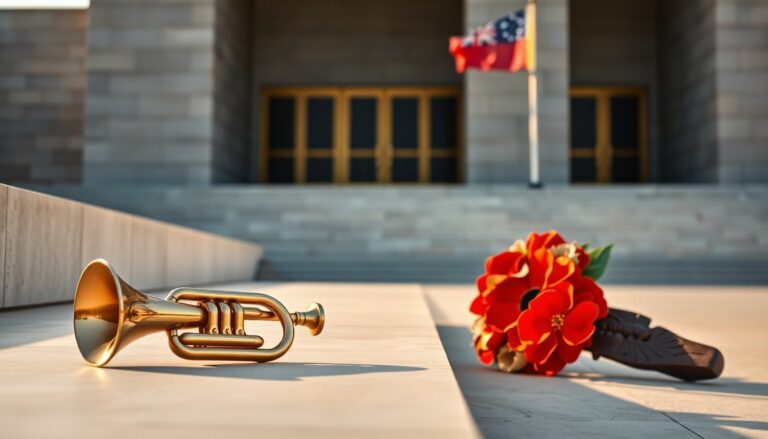
The occasion was a Last Post Ceremony, a nightly ritual that offers storytelling, reflection and the sounding of the bugle.
The ceremony is run each evening and places a spotlight on one serviceperson at a time through a short narrative followed by the traditional musical tribute. For visitors and staff alike, the event operates as a compact, solemn moment that connects contemporary audiences to individual stories from Australia’s military past.
The Last Post Ceremony and its role
The Last Post Ceremony is an intimate ritual meant to honour a single serviceperson through biography, context and the music that closes the ceremony. As a public programme, it is designed to be accessible: attendees hear about a person’s service, often learn personal details shared by family or researchers, and then witness the sounding of the bugle. In this setting, the ceremony functions both as a memorial practice and as a daily educational moment, encouraging reflection on personal sacrifice even when attendance is brief. The duke’s presence underlined the international and national attention these rituals can attract.
Format and public engagement
Beyond its emotional content, the ceremony acts as an interpretive tool: the memorial uses it to present stories that span conflicts, ranks and backgrounds. Visitors leave with a concentrated sense of history that complements the displays in the galleries. The use of short narratives and music ensures that the commemorative act remains consistent while drawing attention to individual experience rather than only large-scale events. The format has helped the memorial maintain daily visibility and a steady connection with both Canberra residents and tourists.
Reframing the memorial’s scope: the Australian Frontier Wars
The memorial has recently undertaken a reassessment of its remit and will include the Australian Frontier Wars in a gallery planned to open in 2028. This marks a notable change: historically, the institution had argued that frontier fighting fell outside its charter because it did not involve formal Australian military forces. Critics, including many historians, countered that the scale and state involvement in those conflicts made them appropriate for commemoration in the national shrine. The planned gallery aims to present a more complete account of violence that took place across the continent during colonisation.
Historical span and controversy
The conflicts now designated as the Australian Frontier Wars began in the months following the arrival of the First Fleet in January 1788 and extended into the early decades of the twentieth century, continuing after the federation of the Australian colonies in 1901. The inclusion follows public and scholarly pressure to acknowledge that these confrontations involved Indigenous communities and government-backed or paramilitary forces. In September 2026, outgoing memorial chair Brendan Nelson said the institution would work towards “a much broader, much deeper depiction and presentation of the violence committed against Indigenous people”, signalling institutional recognition of the issue.
The memorial’s purpose, collections and commitments
The Australian War Memorial serves as a combined shrine, museum and archival repository dedicated to Australians who have served and died on operations. Opened in 1941, the site houses galleries focused on both world wars and interprets the nation’s military history through objects, records and exhibitions. The memorial’s collections record that more than 1.4 million Australians served across the First and Second World Wars, with more than 60,000 fatalities in the First World War, including thousands lost during Gallipoli. The Second World War mobilisation involved roughly one million Australians, a profound contribution from a small population.
Contemporary ties to the Crown and the defence forces
The institution also reflects formal links between the armed forces and the monarchy: all members of the Australian Defence Force make an oath or affirmation of allegiance to the King in his role as the Australian monarch, committing to serve the country and, in the oath, to “resist His enemies”. As the memorial expands its narratives to include frontier conflicts, it will balance traditional military histories with contested episodes from Australia’s colonial past, aiming to broaden public understanding while preserving its role as a place of remembrance.
