Witness the historic display of the Bayeux Tapestry at the British Museum, where King Charles, President Macron, and Prime Minister Burnham celebrated the enduring bond between the UK and France.
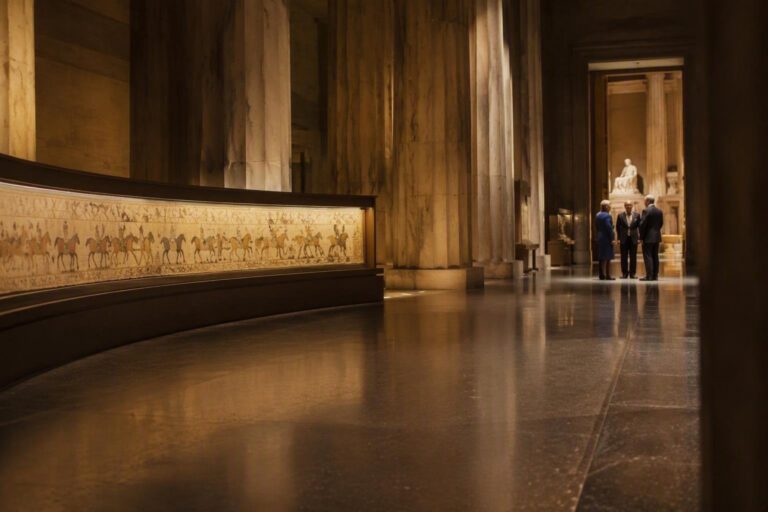
The British Museum in London became the stage for a historic display of Anglo-French unity on Wednesday evening, as King Charles III, French President Emmanuel Macron, and Prime Minister Andy Burnham gathered to view the Bayeux Tapestry. This medieval masterpiece, a woven record of the Norman Conquest, has been loaned to the UK as a symbol of the strong partnership between the two nations.
The event marked the first official joint engagement between King Charles and Prime Minister Burnham since Burnham’s appointment in July. The tapestry, originally embroidered in England but kept in France for centuries, tells the story of the Norman invasion of England in 1066.
Its display in London is a significant cultural and diplomatic exchange, highlighting the shared heritage of the UK and France.
The Bayeux Tapestry: A Story of Shared History
The Bayeux Tapestry a 70-meter-long embroidered cloth, depicts the events leading up to the Battle of Hastings and the Norman Conquest.
It includes 58 separate scenes, with 627 human figures, 737 animals, 37 ships, and 23 trees, accompanied by a Latin narration. The tapestry is believed to have been created by English women for the new Norman rulers in the 1070s.
King Charles, who is a direct descendant of William, Duke of Normandy, spoke about the tapestry’s significance during the event. He noted that the tapestry tells the story of the beginning of what he likes to think of as the French side of his family’s history in these islands. The King emphasized that the tapestry is not merely an English story nor only a Norman one, but a shared history that has brought together the two peoples.
A Symbol of Unity and Diplomatic Exchange
The loan of the Bayeux Tapestry was announced by President Macron during the French state visit to the UK in. It is considered an emblem of the strong partnership between the two countries. The tapestry will be on public display at the British Museum starting next week, with tickets already sold out until the end of 2026.
President Macron highlighted the historical significance of the loan, noting that it had first been proposed in the 1930s. He described the tapestry as a reminder of what the two countries can achieve when they join forces. The French authorities welcomed the display conditions at the British Museum, which are believed to be ideal for the conservation of the delicate fibers.
Key Moments and Future Discussions
During their visit, King Charles, Queen Camilla, Prime Minister Burnham, and their spouses were shown key scenes in the tapestry, including the Coronation of King Harold and his death in battle. The event also provided an opportunity for President Macron to get to know Prime Minister Burnham better. Topics for discussion between the two leaders are expected to include support for Ukraine, the conflict in the Middle East, and relations with the European Union.
As part of the cultural diplomatic exchange, the UK is lending France one of the British Museum’s prize exhibits—the treasures from the Anglo-Saxon Sutton Hoo burial. Culture Secretary Lisa Nandy emphasized the unique shared history between Britain and France, stating that the Bayeux Tapestry exhibition will be a memorable experience for a generation of British children.
The Bayeux Tapestry exhibition is not only a celebration of shared heritage but also a testament to the enduring bond between the UK and France. As King Charles and President Macron noted, the tapestry’s story is one of ambition, uncertainty, and consequences, reflecting the complex and intertwined histories of the two nations.