

Kuwait's defence ministry has condemned an Iranian drone attack on its international airport, resulting in one fatality and numerous injuries. Stay informed about the ongoing conflict in the Gulf.
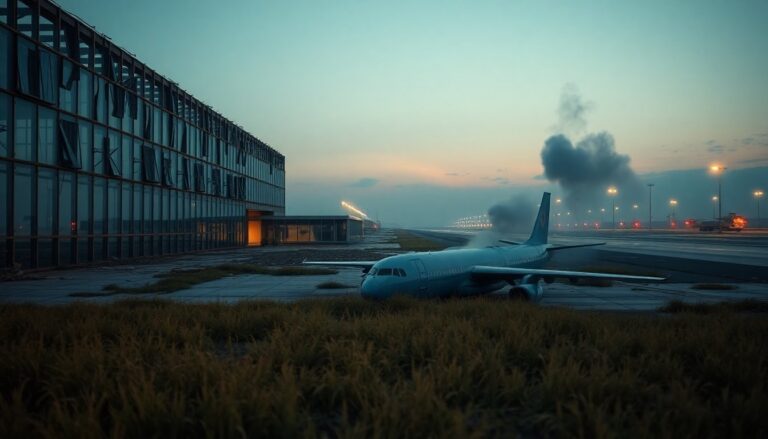
The Gulf region is once again in the spotlight as Kuwait’s defence ministry strongly condemned an attack on its international airport, labeling it as heinous Iranian aggression. The incident, which occurred on Wednesday, resulted in one fatality and left dozens injured, causing significant material damage to the airport terminal.
The attack, carried out by Iranian drones, has further escalated tensions in an already volatile region. As the world watches, the situation continues to unfold with potential implications for global security and stability.
The Escalating Conflict
The recent attack on Kuwait’s international airport is not an isolated incident.
It is part of a broader pattern of escalating tensions between Iran and its neighbors, as well as the United States. The US and Iran have exchanged fresh missile and drone strikes, further complicating efforts to secure a new ceasefire agreement.
Donald Trump, in an interview released on Wednesday, stated that talks with Iran were continuing and he was not looking to escalate the situation. However, he also claimed that Iran was pretty close to signing a peace agreement with the US, suggesting that a resolution could be imminent.
The Role of International Actors
Benjamin Netanyahu, the Israeli prime minister, has been vocal about the situation, warning that Iran was playing with fire. He suggested that Trump could order a full-scale return to military action if negotiations fail. Netanyahu also criticized European leaders for their stance on the Israeli military campaign, accusing them of catering to radical Islamic minorities.
The US military’s Central Command (Centcom) reported that it had targeted an unladen tanker, the Botswana-flagged M/T Lexie, on Tuesday. The tanker was attempting to break through the American blockade of the Strait of Hormuz. In response, Iran’s Islamic Revolutionary Guard Corps (IRGC) claimed to have attacked the US Fifth Fleet headquarters in Bahrain with missiles and drones, a claim denied by the US military.
The Human Cost
The human cost of the conflict is evident in the recent attack on Kuwait’s international airport. Kuwait’s defence ministry spokesperson, Brig Gen Saud Abdulaziz Al-Atwan, described the attack as criminal Iranian aggression which resulted in significant material damage to the building and injuries to civilians.
Kuwait’s state news agency reported that civil aviation authorities had suspended traffic and transferred incoming flights to alternative airports. The incident has further strained relations between Kuwait and Iran, with Kuwait’s deputy foreign minister summoning Iran’s chargé d’affaires to formally protest over Iran’s continued attacks.
The Broader Implications
The latest exchange of strikes underlines the lack of political progress in resolving the Middle East crisis. Despite upbeat claims from the US secretary of state, Marco Rubio, the situation remains volatile. Rubio reiterated that a deal was within reach, but the messaging from Iran indicates a different perspective.
Iran’s foreign minister, Abbas Araghchi, stated that the ceasefire between Iran and the US was unequivocally a ceasefire on all fronts, including in Lebanon. He warned that any violation on one front was a violation of the ceasefire on all fronts, holding the US and Israel responsible for the consequences.
The situation in Lebanon remains tense, with Israeli warplanes launching dozens of strikes across southern Lebanon despite the new agreement supposedly brokered by Trump. The US president confirmed reports that he had described Netanyahu as crazy, indicating the complexity of the diplomatic efforts.
As the world watches, the situation in the Gulf continues to evolve. The recent attack on Kuwait’s international airport serves as a stark reminder of the ongoing conflict and the need for a peaceful resolution. The international community must work together to de-escalate the situation and prevent further loss of life and damage to infrastructure.
