

Witness how hundreds of black-clad protesters brought Dover's port to a halt, causing widespread disruption and raising questions about police preparedness.
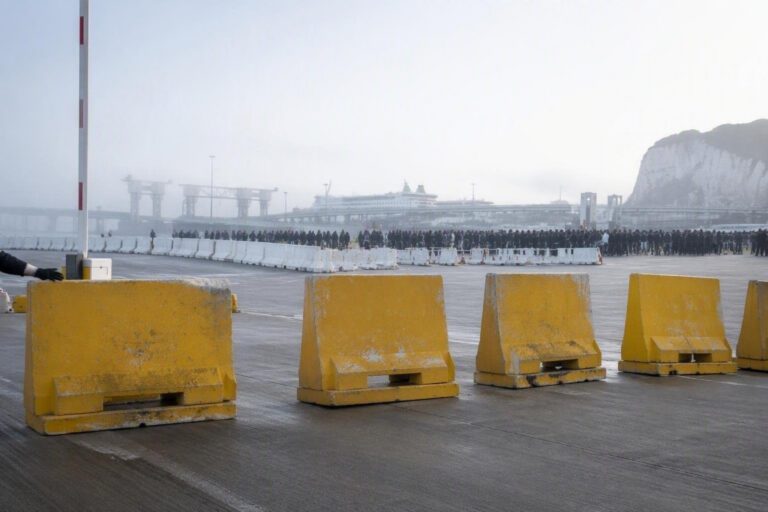
The Port of Dover, a critical hub for international travel and trade, faced significant disruption on the morning of September 6, 2026, as hundreds of black-clad protesters blocked key access roads. The protest, organized by an anti-immigration group with far-right links, saw participants wearing balaclavas and marching in coordinated groups, causing delays and congestion that rippled through the region.
The incident has sparked a debate about the effectiveness of police response and the nature of the protest itself. With no arrests made and the protesters dispersing by midday, the event has left many questioning the balance between the right to peaceful protest and the maintenance of public order.
Protesters’ tactics and police response
The protesters, estimated to be around 300 men, employed a tactic of linking arms to form human blockades across the A20, a major road leading to the port. Videos shared online showed the demonstrators chanting slogans such as “stop the boats” and “England till I die” while lorries and other vehicles were forced to halt.
The Port of Dover described the incident as a public order incident and Kent Police confirmed their presence, engaging with the protesters throughout the morning.
Despite the significant disruption, no arrests were made. The protesters dispersed by lunchtime, allowing traffic to resume its normal flow. However, the incident caused delays of up to 30 minutes and resulted in four miles of congestion, according to National Highways. The Port of Dover and ferry operators pledged to accommodate affected travelers on the next available sailings, mitigating some of the inconvenience caused by the protest.
The role of far-right activists
The protest appears to have been organized by Patriot Platform a group that describes itself as having a “fierce love for our homeland”. The group’s founder, Danny Thomas, also known as Danny Tommo, posted live streams and messages on social media, encouraging more people to join the protest. In a video posted on September 2, Thomas hinted at a coordinated effort to send a message to the government, stating, “Very, very soon, we are going to send a message that will make sure they understand that we will not go down without a fight.”
Far-right activist Tommy Robinson whose real name is Stephen Yaxley-Lennon, also played a role in promoting the protest. He reposted videos of the blockade and encouraged his followers to support the demonstrators. Robinson’s involvement has drawn attention to the broader network of far-right activists and their strategies for mobilizing support.
Public reaction and political response
The protest has drawn mixed reactions from the public and political figures. Mike Tapp, the Labour MP for Dover and Deal, criticized the protesters, describing them as “idiots coming to Dover to cause disruption.” He pointed out that small boat crossings have decreased by 40% and that efforts are being made to address the issue. Tapp also expressed concern about the intimidating nature of the protest, noting that the use of balaclavas and paramilitary gear was particularly alarming.
Chris Vinson, the leader of the Conservative group on Dover district council, acknowledged the protest’s intimidating nature but noted that there had been no reported violence. He expressed concern about the lack of advance warning from the police, which left many residents feeling unsafe. The government has condemned the protest and the disruption it caused, emphasizing the importance of peaceful protest while acknowledging the frustration of those affected.
The incident has raised questions about the effectiveness of police preparedness and the need for better coordination in managing such protests. As the UK continues to grapple with issues of immigration and public order, the events in Dover serve as a stark reminder of the challenges ahead.
