Romanian authorities claim a Russia‑directed sabotage network set the fire near a Brasov weapons plant, linking it to a wider campaign against European defence sites.
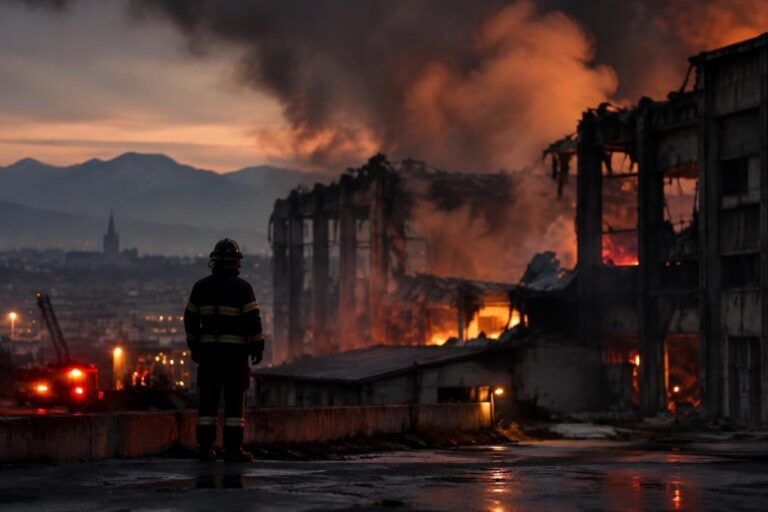
On September 14, a fire erupted at an industrial complex adjacent to a state-owned weapons manufacturer in the central Romanian city of Brasov. The blaze, which quickly attracted the attention of local emergency services, was later described by the country’s intelligence agency as more than a simple accident.
According to the Romanian Intelligence Service, the inferno is believed to belong to a systematic pattern of sabotage operations that have been orchestrated by the Russian Federation across European territory. The agency’s statement emphasized that the target profile includes “arms producers and other sites of military and industrial relevance,” suggesting a strategic motive behind the destruction.
Brasov fire tied to a Russia-coordinated sabotage network
The investigation carried out by the Directorate for Investigating Organized Crime and Terrorism (DIICOT) identified three individuals allegedly involved in the incident: two citizens of Belarus and one Ukrainian, all residing in European Union member states.
Police apprehended the two Belarusians in Germany just as they were preparing similar acts, while the Ukrainian suspect remains at large in Poland.
Romanian officials explained that recruitment for such clandestine cells often starts on social-media platforms, where operatives are offered modest sums for “apparently harmless tasks” such as photographing or monitoring a location. Over time, the assignments allegedly evolve, potentially encompassing vandalism, arson or even lethal actions, according to the intelligence brief.
A wider wave of covert attacks on European defence assets
Authorities noted that the Brasov incident fits into a broader series of sabotage events recorded in recent weeks. In September, the Bulgarian arms producer EMCO suffered a blast and a separate fire at two of its ammunition depots. In Germany, fire-bombs were tossed near a defence-technology firm in Munich, and a Russian national was detained for allegedly documenting military installations for future attacks.
Italy experienced a similar episode in August when a blast struck an ammunition factory near Rome operated by the Franco-German consortium KNDS. Maritime security has also been compromised: at least eight cargo vessels have been struck off the coasts of Romania and Bulgaria in the last three weeks, resulting in roughly 34 sailors dead or missing.
Romania’s response and the hybrid-war narrative
President Nicusor Dan, a centrist figure, has repeatedly warned that Romania is the target of a hybrid war waged by Moscow to destabilise nations that support Kyiv. He pointed to drone incursions into Romanian airspace, cyber intrusions, disinformation streams and sabotage attempts as components of this multifaceted campaign.
Foreign Minister Dan Neculaescu echoed the sentiment, declaring that the Brasov fire is “part of a broader sabotage campaign across Europe” aimed at weakening defence capabilities. He added on the social platform X that “hybrid attacks will not hold us back from strengthening our resilience and defense.” The Romanian government has tightened security at critical infrastructure sites and intensified cooperation with NATO allies to counter the perceived threat.