A 57-year-old Swede has made a duvet nest under the portico of a vast Knightsbridge property, highlighting tensions over empty luxury homes and frozen assets
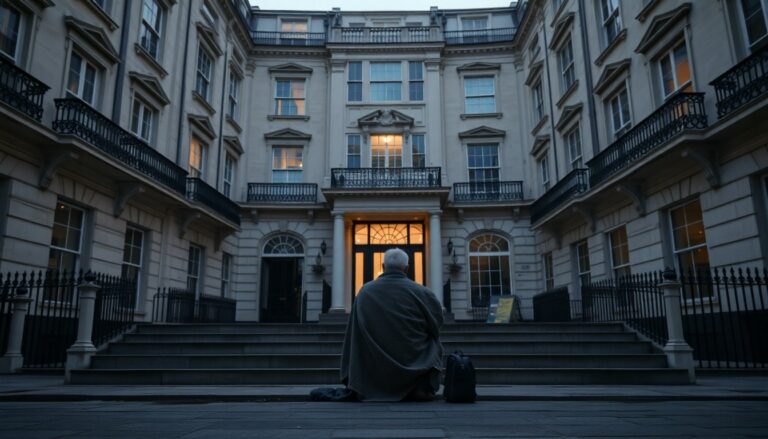
The row of houses known as 2-8a Rutland Gate is one of the most extraordinary private residences in London. Built in a Regency style, the building rises seven storeys, covers 62,000 square feet, contains around 45 rooms and looks out over Hyde Park through dozens of bulletproof windows.
Despite this opulence, the doorstep — rather than the interior — has been home to a single man for years. The man, a friendly and bearded 57-year-old Swedish former journalist and gardener, has deliberately made a snug arrangement of duvets, eiderdowns and Hungarian goose-down pillows beneath the building’s grand portico.
Neighbours and passers-by now know him well. He keeps a wardrobe of smart donated clothes, stacks of toys and flowers around his sleeping area and says he never asks for assistance. His presence has become a curious contrast to the building’s long vacancy: while the mansion is tied up in legal and financial difficulties, the street-level life has been enlivened by this informal steward.
The scene prompts larger questions about the use of high-value properties and the human stories that exist around them.
The house and its complicated ownership
Originally four terraced houses in the 19th century, the site was reunited and rebuilt into a single palatial property in the 1980s. Owners over time included high-profile international figures who treated the address as a prestige asset rather than a primary residence. The mansion once displayed lavish fittings such as 24 marble bathrooms and gold fixtures; many of those items were later sold at auction in a large dispersal. In 2026 the property made headlines when it was purchased for about £210million, temporarily placing it among Britain’s most expensive homes.
Plans, stripping and stalled works
The buyer had obtained planning permission for an extensive extension that would have added a spa, an Olympic-sized swimming pool, a multi-storey underground car park and a soaring conservatory. None of those renovations were completed. Inside, much of the ornate interior had already been removed and sold, leaving the block essentially stripped bare. Estate agents and experts say that restoring or converting the building would require a lengthy refurbishment program likely spanning several years and costing many millions, an unattractive prospect for buyers who expect finished perfection.
Legal entanglements and market fallout
The sale that brought the property into its current limbo involved a Chinese property magnate associated with the Evergrande group. After Evergrande collapsed under huge debts and the founder faced legal action and penalties, the title remained in the name of his then-wife through a British Virgin Islands company. Because her assets are currently frozen amid divorce and other proceedings, the house cannot be marketed or sold to satisfy creditors. Those freezes, together with shifting market demand for trophy London addresses and tightened tax rules, have left the mansion in an unresolved and increasingly dilapidated state.
Market context and local reaction
In recent years the neighbourhood has felt the impact of fewer buyers for ultra-high-end homes and a selective client base demanding turnkey perfection. Locals describe the property as a wasted asset and a blight when empty: a grand facade with many blank windows. Yet in the absence of regular occupants, some residents say the Swedish man provides warmth and a reminder that actual human life can occupy and animate even the most ostentatious addresses.
An unconventional guardian and a wider debate
The man who sleeps under the mansion’s portico has a varied personal history — training at a botanical garden, working in gardening and brief spells living in council accommodation and even on a boat — but chose this particular spot for its proximity to Hyde Park and the swans he enjoys watching. He insists he has never entered the private interior and prefers to remain on the threshold. Neighbours bring him food, clothes and small items, and many describe him as polite, clean and very sociable; he in turn keeps the doorstep cluttered to discourage others from settling there.
His presence raises broader questions about empty luxury property and social priorities: should high-value homes sit unused while others search for housing? Planners, estate agents and residents offer differing views. Some defend the right to private ownership and note the complications of international finance and legal freezes; others call for policies that encourage productive use or greater taxation of unused properties. For now, the mansion remains in stasis, its future dependent on legal outcomes, and the man on the portico continues to act as an informal steward of a famous and otherwise vacant London address.