Four people rushed to hospital after an ambulance flipped at the busy A13/A130 junction while multiple crews treated casualties at the scene
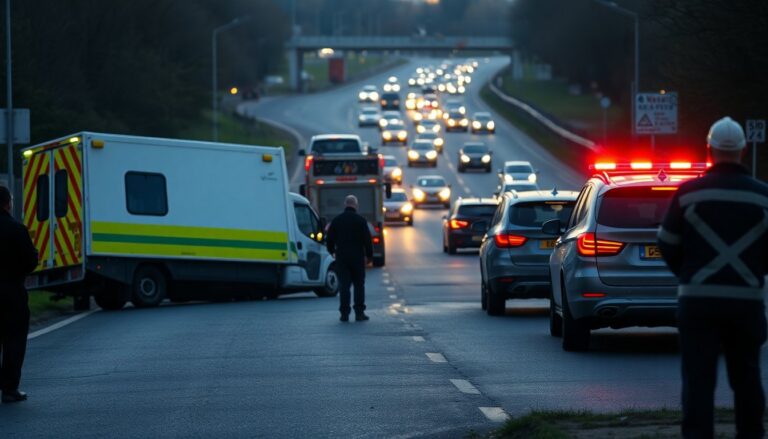
On 24 April 2026 a serious collision at the junction of the A13 and A130 in Bowers Gifford, Essex, left an ambulance on its side and several people injured. Witness photographs circulating online showed the overturned ambulance beside a flat-bed truck and a large four-by-four blocking the carriageway, with traffic ground to a near standstill.
Emergency services moved quickly to secure the scene and prioritise casualty care while the surrounding lanes filled with stationary vehicles and drivers were advised of significant delays.
Initial response and casualties
Crews from the East of England Ambulance Service reported that a total of six ambulances and two paramedic cars were dispatched alongside the East Anglian Air Ambulance.
At the scene, emergency teams assessed five patients, ultimately transporting four people to Basildon and Thurrock Hospital by road ambulance. The coordinated arrival of multiple resources reflected the scale of the incident and the need for rapid triage, stabilisation and transfer for those requiring further treatment at hospital.
What the scene looked like
Photographs from the junction captured the overturned vehicle adjacent to a tipped flat-bed truck and a dark four-by-four sitting in the middle of the carriageway. Police collision investigation teams were on site to document the wreckage and gather evidence while firefighters and ambulance personnel worked to ensure that no one remained trapped. The visible disruption on the A13 and A130 prompted traffic management measures and warnings to motorists to expect continuing delays in the area.
Medical care provided at scene and hospital transfers
The East Anglian Air Ambulance confirmed that its Anglia Two (Cambridge) crew was tasked to support the response near Basildon. Pilots from Babcock landed the helicopter in a nearby field to enable clinicians to reach the scene quickly. Doctor David and Critical Care Paramedic Gary carried out assessments on four adults — two women and a man in their forties and a woman in her fifties — and provided A & E level care to another man in his fifties, including advanced pain relief. One patient was accompanied by the HEMS team to Basildon and Thurrock Hospital by road ambulance for further treatment.
Air ambulance role and definitions
The air unit performed a rapid-response role often associated with HEMS deployments; HEMS stands for Helicopter Emergency Medical Service, which brings senior clinicians to complex scenes. In this incident, the helicopter’s presence allowed for enhanced on-scene triage and critical interventions before hospital transfer. While not every casualty required air transport, the HEMS team’s advanced capabilities — such as administering controlled analgesia and conducting comprehensive trauma assessments — were important in stabilising patients prior to handover.
Traffic disruption and ongoing investigation
Police units tasked with collision investigation remained at the junction to reconstruct events and collect witness statements. Motorists in the vicinity experienced substantial hold-ups while lanes were closed and recovery teams cleared damaged vehicles. Authorities urged drivers to avoid the area where possible and follow diversionary signage. The presence of specialist investigators underlines that a formal inquiry into the sequence of events and contributory factors is under way.
Next steps and public advice
Investigators will examine vehicle positions, witness accounts and any available camera footage to establish how the crash unfolded and whether any safety measures could be recommended. At this stage, officials have not released determinations about cause or liability. The public is advised to allow space for emergency services, to heed traffic updates and to use alternative routes until police and highways teams confirm the carriageway is fully reopened. Families of those affected are being supported while clinical teams continue follow-up care at hospital.